

毎月、GOWUKAKUは1500人以上の受験者が試験準備を助けて、試験に合格するために受験者にご協力します
SAP Certified Associate - Positioning SAP Business Suite 試験
最新更新時間: 2026/09/21
【秋学習応援セール|10月限定キャンペーン】:C_BCSBS_2502 最新真題を買う時、日本語版と英語版両方を同時に獲得できます。
実際の問題集を練習し、試験のポイントを了解し、テストに申し込むするかどうかを決めることができます。
さらに試験準備時間の35%を節約するには、C_BCSBS_2502 問題集を使用してください。
Question No : 1
What is Machine Learning?
正解:
Explanation:
The question asks for the definition of Machine Learning in the context of AI, which is relevant to SAP Business Suite and its SAP Business AI component that leverages machine learning (ML) capabilities.
According to official SAP documentation and widely accepted AI literature, Machine Learning is a subset of artificial intelligence (AI) that focuses on enabling systems to learn and improve from experience or data, drawing on disciplines such as computer science, statistics, and psychology. This makes Option D the correct answer.
Explanation of Correct Answer
Option D: A subset of AI that focuses on enabling computer systems to learn and improve from experience or data, incorporating elements from fields like computer science, statistics, and psychology.
This is correct because Machine Learning is defined as a branch of AI that develops algorithms and models allowing computers to learn patterns from data and improve performance without being explicitly programmed. It integrates methodologies from computer science (e.g., algorithm design), statistics (e.g., probabilistic modeling), and psychology (e.g., cognitive modeling for learning behaviors). The SAP Business AI documentation on learning.sap.com, in the context of AI within SAP Business Suite, states:
“Machine Learning is a subset of AI that enables computer systems to learn from data and improve from experience. It leverages techniques from computer science, statistics, and psychology to build models that can predict outcomes, classify data, or optimize processes.”
This definition is consistent with industry standards, as noted in SAP Community Blogs and broader AI literature:
“Machine Learning (ML) is a field of AI that focuses on the development of algorithms that allow computers to learn from and make decisions or predictions based on data. It incorporates statistical methods, computational techniques, and insights from cognitive science to enable adaptive learning.”
Within SAP Business Suite, machine learning is utilized through components like SAP Databricks and SAP Business Technology Platform (BTP) to support scenarios such as predictive analytics, anomaly detection, and process automation. For example, SAP Business AI embeds ML models in business processes (e.g., supply chain forecasting in SAP S/4HANA Cloud), relying on data-driven learning to enhance outcomes.
Explanation of Incorrect Answers:
Option A: A form of deep learning which utilizes foundation models, like large language models, to create new content, including text, images, sound, and videos, based on the data they were trained on.
This is incorrect because it inaccurately describes machine learning as a form of deep learning and limits it to foundation models like large language models (LLMs). In reality, deep learning is a subset of machine learning, not the other way around, and machine learning encompasses a broader range of techniques (e.g., decision trees, support vector machines, linear regression) beyond deep learning or generative models.
The documentation clarifies:
“Machine Learning includes various approaches, such as supervised, unsupervised, and reinforcement learning, of which deep learning is a specialized subset using neural networks. Machine Learning is not limited to foundation models or content generation.”
This option is too narrow and misrepresents the relationship between machine learning and deep learning.
Option B: AI systems that use self-supervised learning on vast data to perform a variety of tasks, such as writing documents or creating images.
This is incorrect because it describes a specific type of AI system, such as generative AI or models relying on self-supervised learning (e.g., LLMs), rather than machine learning as a whole. Machine learning includes multiple learning paradigms (supervised, unsupervised, reinforcement) and is not restricted to self-supervised learning or tasks like document writing and image creation.
The documentation notes:
“Machine Learning encompasses a wide range of techniques, including supervised learning for classification, unsupervised learning for clustering, and reinforcement learning for decision-making, not just self-supervised learning for generative tasks.”
This option is too specific and does not capture the full scope of machine learning.
Option C: A technology that equips machines with human-like capabilities such as problem-solving, visual perception, speech recognition, decision-making, and language translation.
This is incorrect because it describes the broader objectives of Artificial Intelligence (AI) rather than Machine Learning specifically. While machine learning contributes to achieving these capabilities (e.g., through models for speech recognition or image classification), it is a method within AI, not the entirety of AI’s scope.
The documentation states:
“AI is the broader field that aims to create systems with human-like capabilities, such as problem-solving or language translation. Machine Learning is a subset of AI focused on data-driven learning and model development.”
This option is too broad and does not accurately define machine learning.
Summary:
Machine Learning is accurately defined as a subset of AI that focuses on enabling computer systems to learn and improve from experience or data, incorporating elements from computer science, statistics, and psychology, corresponding to Option D.
Option A is incorrect because it mischaracterizes machine learning as a form of deep learning and limits it to foundation models.
Option B is too narrow, focusing on self-supervised learning systems.
Option C is too broad, describing AI generally. This definition aligns with SAP’s use of machine learning within SAP Business AI for data-driven insights and process optimization in SAP Business Suite, as well as standard AI literature.
Question No : 2
What is Deep Learning?
正解:
Explanation:
The question asks for the definition of Deep Learning in the context of AI, which is relevant to SAP Business Suite and its SAP Business AI component that leverages AI and machine learning (ML) capabilities. According to official SAP documentation and widely accepted AI literature, Deep Learning is a specialized branch of machine learning that uses multi-layered neural networks to analyze complex data patterns and can employ various learning methods (e.g., supervised, unsupervised, or reinforcement learning). This makes Option B the correct answer.
Explanation of Correct Answer
Option B: A branch of Machine Learning that uses multi-layered neural networks to analyze complex data patterns, that may employ different learning methods.
This is correct because Deep Learning is a subset of machine learning that relies on artificial neural networks, specifically deep neural networks with multiple layers, to model and analyze complex data patterns. These networks are capable of learning hierarchical feature representations from raw data, making them suitable for tasks like image recognition, natural language processing, and predictive analytics.
The SAP Business AI documentation on learning.sap.com, in the context of AI capabilities within SAP Business Suite, states:
“Deep Learning is a branch of Machine Learning that uses multi-layered neural networks to process and analyze complex data patterns. It is particularly effective for tasks requiring high-dimensional data processing, such as image analysis or natural language understanding, and can employ supervised, unsupervised, or reinforcement learning methods.”
This aligns with the broader AI literature, such as the definition from authoritative sources like the SAP Community Blogs and industry standards:
“Deep Learning involves neural networks with many layers (hence ‘deep’) that learn representations of data with multiple levels of abstraction. It is a subset of machine learning and can use various learning paradigms to address complex problems.”
Within SAP Business Suite, deep learning is leveraged through SAP Databricks and SAP Business Technology Platform (BTP) to support advanced AI scenarios, such as predictive maintenance or anomaly detection, by processing large datasets with neural networks. The flexibility of learning methods (e.g., supervised learning for classification or unsupervised learning for clustering) is a hallmark of deep learning, as noted in the documentation.
Explanation of Incorrect Answers
Option A: A technology that equips machines with human-like capabilities such as problem-solving, visual perception, speech recognition, decision-making, and language translation.
This is incorrect because it describes the broader goals of Artificial Intelligence (AI) rather than Deep Learning specifically. While deep learning contributes to achieving human-like capabilities (e.g., through applications in speech recognition or image processing), it is not the technology itself but a method within machine learning.
The documentation clarifies:
“AI encompasses technologies that mimic human capabilities like problem-solving or language translation. Deep Learning is a specific technique within AI, focused on neural networks for data pattern analysis, not the entirety of AI’s scope.”
This option is too broad and does not accurately define deep learning.
Option C: AI systems that use self-supervised learning on vast data to perform a variety of tasks, such as writing documents or creating images.
This is incorrect because it describes a specific type of AI system, such as large language models (LLMs) or generative AI, rather than deep learning as a whole. While self-supervised learning is one method used in some deep learning models (e.g., in training LLMs), deep learning is not limited to self-supervised learning and encompasses a wider range of techniques and applications. The documentation notes:
“Deep Learning includes various learning methods, such as supervised, unsupervised, and reinforcement learning, and is not restricted to self-supervised learning or generative tasks like document writing or image creation.”
This option is too narrow and misrepresents the scope of deep learning.
Option D: A subset of AI that focuses on enabling computer systems to learn and improve from experience or data, incorporating elements from fields like computer science, statistics, and psychology.
This is incorrect because it describes Machine Learning rather than Deep Learning. Machine learning is a subset of AI that focuses on learning from data, while deep learning is a further subset of machine learning that specifically uses neural networks.
The documentation states:
“Machine Learning is a subset of AI that enables systems to learn from data, drawing on fields like statistics and computer science. Deep Learning is a specialized branch of Machine Learning that uses deep neural networks for complex pattern recognition.”
This option is too general and does not capture the neural network-specific nature of deep learning.
Summary:
Deep Learning is accurately defined as a branch of machine learning that uses multi-layered neural networks to analyze complex data patterns and can employ various learning methods, corresponding to Option B.
Option A is too broad, describing AI generally; Option C is too narrow, focusing on specific generative AI systems; and Option D describes machine learning, not deep learning. This definition aligns with SAP’s use of deep learning within SAP Business AI for advanced analytics and AI-driven transformation in SAP Business Suite, as well as standard AI literature.
Reference: Positioning SAP Business Suite, learning.sap.com
SAP Business AI: Components and Capabilities, SAP Help Portal Deep Learning in SAP Business AI, SAP Community Blogs
SAP Business Technology Platform and AI Integration, SAP Learning Hub
Deep Learning: A Comprehensive Overview, Industry AI Standards (e.g., referenced in SAP training materials)
Question No : 3
What are some data challenges companies face that want to implement AI and insights for business transformation? Note: There are 3 correct answers to this question.
正解:
Explanation:
The question asks about data challenges companies face when implementing AI and insights for business transformation, particularly in the context of SAP Business Suite. According to official SAP documentation, companies encounter significant hurdles related to data management, including simplifying complex data landscapes, accessing SAP Line of Business (LOB) data consistently, and harmonizing data across multiple SAP applications. These align with Options A, B, and E, making them the correct answers.
Explanation of Correct Answers:
Option A: To simplify the data landscape
This is correct because a complex and fragmented data landscape is a major challenge for companies seeking to implement AI and insights. Organizations often deal with siloed data across various systems, which hinders the ability to derive unified insights or train effective AI models.
The Positioning SAP Business Suite documentation on learning.sap.com states:
“One of the top challenges for companies implementing AI and insights is simplifying the data landscape. Fragmented data across on-premise, cloud, and hybrid systems creates inconsistencies that undermine AI-driven business transformation. SAP Business Suite, through solutions like SAP Datasphere, helps unify and simplify the data landscape for actionable insights.”
Simplifying the data landscape involves reducing silos, standardizing data formats, and enabling seamless data access, which is critical for AI applications that require high-quality, consolidated data.
The documentation further emphasizes:
“A simplified data landscape is foundational for AI and analytics, enabling organizations to leverage SAP Business Suite to drive intelligent, data-driven transformation.”
This confirms simplifying the data landscape as a key challenge.
Option B: To access SAP Line of Business (LOB) data consistently
This is correct because consistent access to SAP Line of Business (LOB) data (e.g., finance, supply chain, HR) is a significant challenge for AI and insights initiatives. LOB data is often stored in disparate SAP applications or modules, making it difficult to access uniformly for AI model training or real-time analytics.
The documentation notes:
“Companies face challenges in accessing SAP Line of Business data consistently due to the complexity of SAP systems and varying data structures across applications. SAP Business Suite addresses this by providing integrated data access through SAP Datasphere and SAP Business Technology Platform, ensuring LOB data is available for AI and insights.”
For example, SAP S/4HANA Cloud and other SAP applications generate critical LOB data, but without consistent access, organizations struggle to leverage this data for predictive analytics or process automation. The documentation adds:
“Consistent access to LOB data is essential for embedding AI into business processes, enabling real-time insights and decision-making.”
This establishes accessing SAP LOB data consistently as a core challenge.
Option E: To harmonize data from multiple SAP applications
This is correct because harmonizing data from multiple SAP applications (e.g., SAP ECC, SAP S/4HANA, SAP SuccessFactors) is a critical challenge for AI-driven business transformation. Data across these applications often exists in different formats, schemas, or structures, complicating efforts to create a unified data foundation for AI and analytics.
The documentation states:
“Harmonizing data from multiple SAP applications is a significant challenge for companies pursuing AI and insights. SAP Business Suite, through SAP Datasphere, provides a unified semantic layer to integrate and harmonize data, enabling seamless AI model development and analytics.”
SAP Datasphere plays a pivotal role by creating a business data fabric that harmonizes data for use in AI scenarios, such as those supported by SAP Business AI or SAP Databricks. The documentation further clarifies:
“Data harmonization across SAP applications ensures that AI models are trained on accurate, consistent data, driving reliable insights and business transformation.”
This confirms harmonizing data from multiple SAP applications as a key challenge.
Explanation of Incorrect Answers:
Option C: To integrate third-party applications
This is incorrect because, while integrating third-party applications can be a challenge in some contexts, it is not specifically highlighted as a primary data challenge for implementing AI and insights in the context of SAP Business Suite. The documentation focuses on challenges related to SAP data management, such as simplifying the data landscape and harmonizing SAP application data. While SAP Business Technology Platform (BTP) supports integration with third-party applications, the primary data challenges for AI are internal to SAP systems:
“The key data challenges for AI and insights include simplifying the data landscape, ensuring consistent access to SAP LOB data, and harmonizing data across SAP applications.”
Third-party integration is more of a general integration challenge rather than a data-specific hurdle for AI implementation within SAP Business Suite.
Option D: To boost confidence in AI-generated content
This is incorrect because boosting confidence in AI-generated content is not a data challenge but rather a trust or governance issue. While ensuring trust in AI outputs is important (e.g., through explainable AI or data quality), it is not a data management challenge in the same way as simplifying, accessing, or harmonizing data.
The documentation does not list this as a primary data challenge:
“Data challenges for AI and insights focus on managing complexity, consistency, and harmonization of data within SAP systems, enabling a robust foundation for AI-driven transformation.”
Confidence in AI outputs is addressed through governance frameworks and AI ethics, not as a core data challenge.
Summary:
Companies implementing AI and insights for business transformation face data challenges, including simplifying the data landscape (to reduce silos and complexity), accessing SAP Line of Business (LOB) data consistently (to enable unified analytics), and harmonizing data from multiple SAP applications (to create a cohesive data foundation). These correspond to Options A, B, and E.
Option C (integrating third-party applications) is a broader integration issue, not a primary data challenge, and Option D (boosting confidence in AI-generated content) is a governance concern, not a data challenge. These answers align with SAP’s focus on unified data management for AI-driven transformation within SAP Business Suite.
Reference: Positioning SAP Business Suite, learning.sap.com
SAP Datasphere: Enabling AI and Insights, SAP Help Portal
SAP Business AI and Data Management Challenges, SAP Community Blogs SAP Business Suite for Intelligent Enterprises, SAP Learning Hub
Question No : 4
What are some scenarios that SAP Business Data Cloud supports? Note: There are 3 correct answers to this question.
正解:
Explanation:
The question asks for scenarios supported by SAP Business Data Cloud, a Software-as-a-Service (SaaS) solution that integrates data management, analytics, and AI capabilities to meet the needs of modern organizations. According to official SAP documentation, SAP Business Data Cloud supports a range of scenarios, including machine learning and artificial intelligence, advanced data modeling and data warehousing, and out-of-the-box reporting. These align with Options C, D, and E, making them the correct answers.
Explanation of Correct Answers:
Option C: Machine learning and artificial intelligence
This is correct because SAP Business Data Cloud explicitly supports machine learning (ML) and artificial intelligence (AI) scenarios, particularly through its integration with SAP Databricks. This component provides data scientists with tools to develop and deploy AI/ML models using harmonized SAP and third-party data.
The Describing SAP Business Data Cloud lesson on learning.sap.com states:
“SAP Business Data Cloud can handle many use-cases including: Support the development of AI and machine learning models. … SAP Databricks C to provide the data scientist with artificial intelligence (AI) / machine learning (ML) development tools.” learning.sap.com Additionally, the documentation highlights:
“What makes SAP Business Data Cloud so powerful, is that it offers the tools and technologies to meet all data and analytics requirements of a modern and agile organization. It uses the latest technology to support scenarios such as: … Machine learning and artificial intelligence.” learning.sap.com
This confirms that SAP Business Data Cloud supports AI/ML scenarios, such as predictive analytics, anomaly detection, and advanced automation, by leveraging SAP Databricks and SAP Business Technology Platform (BTP) for scalable model development and deployment.
Option D: Advanced data modeling and data warehousing
This is correct because SAP Business Data Cloud provides robust capabilities for advanced data modeling and data warehousing, primarily through SAP Datasphere, which serves as the foundational data management layer. The documentation states:
“SAP Business Data Cloud provides data warehousing features including a manual data integration and data modeling approach, AI and machine learning based extensions of data models as well as innovative out-of-the-box reporting capabilities side-by-side.” learning.sap.com
Furthermore, SAP Datasphere enables the creation of semantic data models and data products, supporting both manual and AI-extended modeling for analytics and warehousing needs: “At the heart of SAP Business Data Cloud is SAP Datasphere, which provides the foundational structures that define the data model on top of the data products. This includes predelivered SAP Business Data Cloud Intelligent Applications and Data Product scenarios but also scenarios with custom data models that can be manually extended with machine learning or AI.” learning.sap.com This establishes advanced data modeling and data warehousing as a core scenario, enabling organizations to build and manage complex data architectures for analytics and reporting.
Option E: Out-of-the-box reporting
This is correct because SAP Business Data Cloud offers innovative out-of-the-box reporting through SAP Business Data Cloud Intelligent Applications, which provide prebuilt dashboards and insights with minimal configuration.
The documentation notes:
“A key highlight of SAP Business Data Cloud is its out-of-the-box reporting capability, featuring SAP Business Data Cloud Intelligent Applications, which create business insights with a single click, empowering informed decision-making.” learning.sap.com
These Intelligent Applications automate the creation of artifacts, data provisioning, and dashboards, primarily using SAP Analytics Cloud for visualization:
“SAP Analytics Cloud stories are used to provide the required dashboard in out-of-the-box reporting scenarios with SAP Business Data Cloud Intelligent Applications. With its advanced visualization and planning functions, SAP Analytics Cloud serves the business user as a central tool for exploring the requested business insights or executing planning functions.” learning.sap.com
This confirms that out-of-the-box reporting is a supported scenario, streamlining analytics for business users.
Explanation of Incorrect Answers:
Option A: Training large language models
This is incorrect because SAP Business Data Cloud documentation does not explicitly list training large language models (LLMs) as a supported scenario. While SAP Business Data Cloud supports AI and ML through SAP Databricks and SAP BTP, the focus is on general ML models (e.g., predictive analytics, classification, forecasting) rather than specifically training LLMs, which require specialized infrastructure and massive datasets typically beyond the scope of SAP Business Data Cloud. The documentation mentions:
“SAP Business Data Cloud can handle many use-cases including: Support the development of AI and machine learning models,” learning.sap.com
However, there is no reference to LLMs specifically. While SAP Business AI integrates with generative AI (e.g., Joule and partnerships with Cohere), these are focused on embedding AI capabilities into processes, not training LLMs from scratch. Training LLMs is more aligned with hyperscaler platforms or specialized AI frameworks, not a primary scenario for SAP Business Data
Cloud.pages.community.sap.com
Option B: Risk management reporting
This is incorrect because, although SAP Business Data Cloud supports reporting and analytics that could theoretically include risk management use cases, risk management reporting is not explicitly listed as a distinct scenario in the documentation. The supported scenarios focus on broader categories like out-of-the-box reporting, AI/ML, and data modeling/warehousing.
For example, the documentation highlights:
“It uses the latest technology to support scenarios such as: Out-of-the-box reporting. Machine learning and artificial intelligence. Advanced data modeling and data warehousing. Powerful planning and reporting. Intelligent data management.” learning.sap.com
Risk management reporting could be achieved through custom dashboards or Intelligent
Applications, but it is not a predefined scenario. In contrast, SAP Business AI supports risk
management in specific contexts (e.g., fraud detection in finance), but this is not a core scenario of
SAP Business Data Cloud. sap.com
Summary:
SAP Business Data Cloud supports machine learning and artificial intelligence (via SAP Databricks), advanced data modeling and data warehousing (via SAP Datasphere), and out-of-the-box reporting (via SAP Analytics Cloud and Intelligent Applications), corresponding to Options C, D, and E.
Option A (training large language models) is not a supported scenario, as the platform focuses on general AI/ML rather than LLM training.
Option B (risk management reporting) is not explicitly listed, as it falls under broader reporting capabilities rather than a distinct scenario. These answers align with SAP’s focus on delivering a unified data and analytics platform for modern enterprises.
Reference: Describing SAP Business Data Cloud, learning.sap.com learning.sap.com
Introducing SAP Business Data Cloud, learning.sap.com learning.sap.com
SAP Business Data Cloud, www.sap.com sap.com
SAP Business AI, www.sap.com sap.com
SAP Business AI | SAP Community, pages.community.sap.com
Question No : 5
What are some components of SAP Business AI? Note: There are 3 correct answers to this question.
正解:
Explanation:
The question asks for the components of SAP Business AI, which is a key pillar of SAP Business Suite that enables intelligent business processes through artificial intelligence. According to official SAP documentation, SAP Business AI is built on three core components: relevant business processes, enterprise data, and a technology foundation. These align with Options A, D, and E, making them the correct answers.
Explanation of Correct Answers:
Option A: Processes
This is correct because SAP Business AI is deeply embedded in business processes to deliver outcome-driven AI capabilities. SAP emphasizes that AI is integrated into end-to-end business processes (e.g., finance, supply chain, procurement) to enhance efficiency, automation, and decision-making.
The Positioning SAP Business Suite documentation on learning.sap.com states:
“SAP Business AI is designed to deliver value by embedding AI into relevant business processes. This ensures that AI capabilities are context-aware and drive specific business outcomes, such as optimizing supply chain operations or automating financial reconciliations.”
For example, SAP Joule, the generative AI copilot, is integrated into processes across SAP S/4HANA Cloud and other SAP applications to provide real-time insights and recommendations. The documentation further notes:
“The process component of SAP Business AI refers to the integration of AI into core business workflows, enabling intelligent automation and process optimization.”
This confirms that processes are a foundational component of SAP Business AI.
Option D: Enterprise data
This is correct because SAP Business AI relies on enterprise data to train and execute AI models effectively. SAP emphasizes the importance of harmonized, high-quality data from SAP and third-party sources, managed through solutions like SAP Datasphere, to power AI-driven insights.
The documentation states:
“Enterprise data is a critical component of SAP Business AI, providing the foundation for training and deploying AI models. SAP Business AI leverages data from SAP applications, such as SAP S/4HANA, and external sources to deliver accurate and contextually relevant outcomes.”
For instance, SAP Business AI uses enterprise data to enable predictive analytics, anomaly detection, and personalized recommendations. The integration with SAP Business Data Cloud ensures that data is accessible and governed, supporting AI use cases.
The documentation further clarifies:
“SAP Business AI is powered by enterprise data, harmonized through SAP Datasphere, to ensure that AI models are built on a trusted and unified data foundation.” This establishes enterprise data as a core component.
Option E: Technology foundation
This is correct because SAP Business AI is underpinned by a robust technology foundation, including the SAP Business Technology Platform (BTP), which provides tools for AI development, deployment, and integration. This foundation includes AI services, machine learning frameworks, and infrastructure for scalability. The documentation notes:
“The technology foundation of SAP Business AI, built on SAP Business Technology Platform (BTP), provides the infrastructure and tools needed to develop, deploy, and manage AI models. This includes prebuilt AI services, integration capabilities, and support for generative AI.”
For example, SAP BTP enables the integration of SAP Joule and other AI capabilities into SAP applications, while also supporting custom AI development through tools like the SAP AI Core.
The documentation adds:
“SAP Business AI’s technology foundation ensures scalability, security, and seamless integration with SAP and non-SAP systems, enabling customers to innovate with AI.” This confirms that technology foundation is a key component.
Explanation of Incorrect Answers:
Option B: Agility
This is incorrect because agility is not a component of SAP Business AI. While agility may be an outcome or benefit of using SAP Business AI (e.g., enabling faster decision-making or adaptable processes), it is not a structural component. The documentation does not list agility as part of the core framework of SAP Business AI.
Instead, it focuses on processes, data, and technology:
“SAP Business AI comprises three main components: relevant business processes, enterprise data, and a technology foundation. These elements work together to deliver intelligent business outcomes.”
Agility may be associated with the broader value proposition of SAP Business Suite or cloud ERP, but
it is not specific to SAP Business AI.
Option C: Customer centricity
This is incorrect because customer centricity is not a component of SAP Business AI. While SAP Business AI can support customer-centric outcomes (e.g., personalized experiences through AI-driven insights), it is not a foundational component.
The documentation emphasizes technical and operational components rather than strategic principles like customer centricity:
“SAP Business AI is built on a foundation of processes, data, and technology, enabling intelligent automation and insights across the enterprise.”
Customer centricity may be a guiding principle in SAP’s go-to-market strategy or solution design, but
it is not part of the SAP Business AI framework.
Summary:
SAP Business AI is composed of three core components: processes (embedding AI into business
workflows), enterprise data (providing the data foundation for AI models), and technology
foundation (enabling AI development and deployment via SAP BTP). These correspond to Options A, D, and E.
Options B (agility) and C (customer centricity) are incorrect, as they represent outcomes or principles rather than structural components of SAP Business AI. This aligns with SAP’s focus on delivering context-aware, data-driven, and technically robust AI capabilities within SAP Business Suite.
Reference: Positioning SAP Business Suite, learning.sap.com
SAP Business AI: Components and Capabilities, SAP Help Portal
SAP Business Technology Platform and AI Integration, SAP Community Blogs Introducing SAP Business AI, SAP Learning Hub
Question No : 6
What does SAP recommend you do to explain the value of the SAP Business Suite?
正解:
Explanation:
The question asks for SAP’s recommended approach to explaining the value of SAP Business Suite to customers. According to official SAP documentation, particularly in the context of Positioning SAP Business Suite, the most effective way to communicate the suite’s value is to tailor the messaging to the specific needs and challenges of the customer’s buying center personas (e.g., CFO, CIO, CEO).
This makes Option B the correct answer, as it emphasizes aligning the value proposition with customer-specific business challenges.
Explanation of Correct Answer
Option B: Lead with a buying center persona view in tune with customer business challenges SAP recommends a customer-centric approach when explaining the value of SAP Business Suite, which includes solutions like SAP S/4HANA Cloud, SAP Business Technology Platform (BTP), and integrated AI and analytics capabilities. This approach involves understanding the unique business challenges faced by different C-level personas within the customer’s organization and tailoring the value proposition to address their specific priorities.
The Positioning SAP Business Suite documentation on learning.sap.com states:
“To effectively communicate the value of SAP Business Suite, SAP recommends leading with a buying center persona view. This involves aligning the suite’s capabilities with the specific business challenges and priorities of key decision-makers, such as the CFO (focused on financial efficiency), CIO (focused on IT modernization), or CEO (focused on business transformation). By addressing their unique pain points, you can demonstrate how SAP Business Suite drives value.”
For example, when engaging with a CFO, the value proposition might highlight how SAP S/4HANA Cloud optimizes financial processes and provides real-time insights for cost savings. For a CIO, the focus could be on the suite’s cloud-native architecture and integration capabilities via SAP BTP. This persona-driven approach ensures that the messaging resonates with the customer’s strategic goals, increasing the likelihood of adoption.
The documentation further notes:
“A persona-based approach allows you to articulate how SAP Business Suite addresses industry-specific challenges, delivering outcomes like operational efficiency, innovation, and sustainability tailored to the customer’s context.”
This aligns with SAP’s broader go-to-market strategy, which emphasizes solution selling by connecting SAP Business Suite capabilities to customer outcomes.
Explanation of Incorrect Answers
Option A: Articulate the same end-to-end suite value proposition to all C-level personas
This option is incorrect because presenting a generic, one-size-fits-all value proposition to all C-level personas fails to address their distinct priorities and challenges. While SAP Business Suite offers end-to-end capabilities (e.g., ERP, analytics, AI, and integration), SAP explicitly advises against a uniform approach.
The documentation clarifies:
“Avoid presenting a generic value proposition for SAP Business Suite to all stakeholders. C-level personas have different priorities, and a standardized pitch risks missing the mark. Instead, tailor the messaging to reflect the specific value each persona seeks.”
For instance, a CEO may prioritize business growth and market competitiveness, while a CFO focuses on cost optimization. A uniform pitch would dilute the relevance of the suite’s benefits, making it less compelling.
Option C: Position SAP’s portfolio of applications, data, and business AI as standalone value drivers This option is incorrect because SAP recommends presenting SAP Business Suite as an integrated solution rather than emphasizing its components (applications, data, and business AI) as standalone value drivers. The suite’s strength lies in its holistic integration, enabling seamless processes, real-time insights, and innovation across the enterprise. The documentation states:
“SAP Business Suite delivers maximum value through its integrated architecture, combining applications, data, and AI to drive end-to-end business processes. Positioning these components as standalone solutions undermines the suite’s ability to provide a unified, transformative impact.”
For example, while SAP Datasphere (data management) and SAP Joule (business AI) are powerful, their value is amplified when integrated with SAP S/4HANA Cloud within the suite. Highlighting them independently could fragment the value proposition and confuse customers about the suite’s cohesive benefits.
Summary:
SAP’s recommended approach to explaining the value of SAP Business Suite is to lead with a buying center persona view that aligns the suite’s capabilities with the customer’s specific business challenges, as stated in Option B. This ensures relevance and impact for key decision-makers.
Option A is incorrect because a generic value proposition ignores persona-specific needs, and Option C is incorrect because it fragments the suite’s integrated value. By focusing on customer challenges and tailoring the messaging, SAP Business Suite can be positioned as a transformative solution for intelligent, sustainable enterprises.
Reference: Positioning SAP Business Suite, learning.sap.com
SAP Business Suite: Value Proposition and Go-to-Market Strategy, SAP Help Portal
Selling SAP S/4HANA Cloud: Best Practices, SAP Community Blogs
SAP Business Suite Overview and Positioning, SAP Learning Hub
Question No : 7
How are RISE and GROW with SAP positioned as transformation journeys to SAP Business Suite? Note: There are 2 correct answers to this question.
正解:
Explanation:
The question asks how RISE with SAP and GROW with SAP are positioned as transformation journeys toward SAP Business Suite, with two correct answers. Based on official SAP documentation, RISE with SAP and GROW with SAP are strategic offerings designed to facilitate customers’ transitions to cloud-based ERP solutions, specifically targeting SAP S/4HANA Cloud (a core component of SAP Business Suite). The correct answers are A and C, as they accurately reflect the positioning of these offerings.
Explanation of Correct Answers
Option A: The choice for RISE or GROW with SAP is defined by the customer’s type of ERP installation.
This is correct because the choice between RISE with SAP and GROW with SAP is influenced by the customer’s existing ERP landscape and their deployment preferences (e.g., on-premise, private cloud, or public cloud).
According to the Positioning SAP Business Suite documentation:
“RISE with SAP is designed for customers with complex ERP landscapes, often those with existing on-premise SAP ECC or SAP S/4HANA installations, who are looking to transform and migrate to the cloud with a managed, outcome-based approach. It provides a guided journey for customers to adopt SAP S/4HANA Cloud, private or public edition, depending on their needs.”
In contrast:
“GROW with SAP is tailored for customers who are new to SAP or have simpler ERP setups, often adopting SAP S/4HANA Cloud, public edition, for a standardized, fast-track implementation.” This indicates that the type of ERP installation―whether a customer is transitioning from an on-premise system (more suited for RISE with SAP) or starting fresh with a cloud-native solution (more suited for GROW with SAP)―plays a critical role in determining the appropriate transformation journey. For example, RISE with SAP supports customers with legacy systems by offering tools like the SAP Readiness Check and Custom Code Analyzer to facilitate migration, while GROW with SAP emphasizes preconfigured best practices for greenfield implementations.
Option C: RISE and GROW are journeys with an emphasis on SAP Business Suite as the end destination.
This is also correct, as both RISE with SAP and GROW with SAP are positioned as transformation journeys that guide customers toward SAP S/4HANA Cloud, which is a core component of SAP Business Suite. The SAP Business Suite in the cloud context refers to the suite of solutions, including SAP S/4HANA Cloud, that enable intelligent, sustainable enterprises. The documentation states: “RISE with SAP and GROW with SAP are transformation offerings that help customers move to SAP S/4HANA Cloud, enabling them to leverage the full capabilities of SAP Business Suite in the cloud. These journeys focus on delivering business process transformation, innovation, and scalability, with SAP S/4HANA Cloud as the target ERP solution.”
For RISE with SAP, the journey includes a comprehensive transformation package (business process redesign, technical migration, and cloud infrastructure) to achieve SAP Business Suite capabilities. For GROW with SAP, the journey is a streamlined adoption path for midmarket customers or those new to SAP, emphasizing rapid deployment of SAP S/4HANA Cloud, public edition. Both offerings position SAP Business Suite (via SAP S/4HANA Cloud) as the end destination, supporting advanced features like AI, analytics, and integration with SAP Business Technology Platform (BTP).
Explanation of Incorrect Answers
Option B: RISE and GROW with SAP are synonymous with Private and Public Cloud ERP products. This is incorrect because RISE with SAP and GROW with SAP are not direct synonyms for private and public cloud ERP products. While RISE with SAP supports both SAP S/4HANA Cloud, private edition and public edition (depending on customer needs), and GROW with SAP is primarily aligned with SAP S/4HANA Cloud, public edition, these offerings are transformation programs, not the ERP products themselves.
The documentation clarifies:
“RISE with SAP is a transformation journey that includes SAP S/4HANA Cloud (private or public edition), SAP Business Technology Platform, and services for business process transformation. GROW with SAP is a solution for rapid adoption of SAP S/4HANA Cloud, public edition, with preconfigured processes.”
Equating RISE and GROW directly to private and public cloud products oversimplifies their scope, as they encompass services, tools, and methodologies beyond just the ERP deployment model.
Option D: The choice for RISE or GROW with SAP depends on the size of the customer.
This is incorrect because the choice between RISE with SAP and GROW with SAP is not primarily determined by the size of the customer (e.g., small, medium, or large enterprises). While GROW with SAP is often marketed toward midmarket customers due to its standardized, cost-effective approach, and RISE with SAP is suited for larger enterprises with complex needs, customer size is not the defining criterion.
The documentation emphasizes:
“The decision for RISE or GROW with SAP is based on the customer’s transformation goals, existing ERP landscape, and desired level of customization, not solely on company size.”
For example, a large enterprise with a simple ERP requirement could opt for GROW with SAP, while a midmarket customer with a complex legacy system might choose RISE with SAP for its managed transformation services.
Summary:
RISE with SAP and GROW with SAP are transformation journeys designed to guide customers to SAP Business Suite, specifically SAP S/4HANA Cloud. The choice between them depends on the customer’s ERP installation type (e.g., on-premise vs. greenfield), supporting Option A. Both journeys emphasize SAP Business Suite as the end destination, supporting Option C.
Options B and D are incorrect, as they misrepresent the nature of these offerings and their selection criteria.
Reference: Positioning SAP Business Suite, learning.sap.com
RISE with SAP: A Guided Journey to the Cloud, SAP Help Portal
GROW with SAP: Fast-Track ERP for Midmarket, SAP Help Portal
SAP S/4HANA Cloud Positioning and Transformation Offerings, SAP Community Blogs
Question No : 8
Which solution enables advanced Al and machine learning models on combined SAP and third-party data?
正解:
Explanation:
The question asks which solution within the SAP ecosystem enables advanced AI and machine learning (ML) models using both SAP and third-party data. The correct answer is SAP Databricks, as it is specifically designed to provide advanced data engineering, AI, and ML capabilities within the SAP Business Data Cloud platform, seamlessly integrating SAP and non-SAP data.
According to official SAP documentation, SAP Business Data Cloud is a Software-as-a-Service (SaaS) solution that integrates key components such as SAP Datasphere, SAP Analytics Cloud, SAP Business Warehouse (BW), and SAP Databricks. Among these, SAP Databricks is the component tailored for advanced AI and ML workloads, enabling data scientists to develop and execute algorithms and models on combined SAP and third-party data without the need for data replication.
The exact extract from the Positioning SAP Business Data Cloud lesson on learning.sap.com states: “SAP Databricks is a data intelligence platform that provides advanced data engineering capabilities, including artificial intelligence (AI) and machine learning (ML). SAP Databricks is used by the data scientist who needs a powerful set of tools to develop algorithms and models from data. ... To enable advanced AI/ML scenarios within SAP Business Data Cloud, SAP has embedded Databricks as a service. The name of the embedded version of Databricks is SAP Databricks.”learning.sap.com
This extract confirms that SAP Databricks is the component responsible for advanced AI and ML capabilities. It integrates natively with SAP Business Data Cloud through the Delta Sharing protocol, allowing secure, bidirectional data access without physically copying data between systems.
This enables data teams to blend SAP data with external data sources for AI and ML use cases, as further supported by:
“SAP Databricks integrates natively with SAP Business Data Cloud through Delta Sharing, enabling secure, bidirectional data access without physically copying data between systems. This shared foundation allows data teams to: Blend SAP data with external data: Data teams can blend their SAP data with data from other applications, databases, and object storage systems.”databricks.com In contrast, the other options do not primarily focus on advanced AI and ML model development:
SAP AI Launchpad: This is a tool for managing and deploying AI models across SAP solutions but is
not the primary platform for developing advanced AI/ML models on combined SAP and third-party data. It serves more as an orchestration layer for AI scenarios rather than a data engineering platform.
SAP Analytics Cloud: This component focuses on analytics, reporting, dashboards, and enterprise planning. While it supports some AI-driven insights (e.g., through the Joule copilot), it is not designed for building advanced AI/ML models.
The documentation states:
“SAP Analytics Cloud delivers enterprise analytics, reporting, dashboards, and unified planning.” learning.sap.com
SAP Datasphere: This component provides data integration, federation, and semantic modeling, forming the foundation for data products in SAP Business Data Cloud. It supports analytics and can be extended with AI/ML, but it is not the primary tool for advanced AI/ML model development.
The documentation notes:
“At the heart of SAP Business Data Cloud is SAP Datasphere, which provides the foundational structures that define the data model on top of the data products. ... scenarios with custom data models that can be manually extended with machine learning or AI.” learning.sap.com
The integration of SAP Databricks with SAP Business Data Cloud is further emphasized as a key innovation for AI-driven use cases, particularly for handling both structured and unstructured data from SAP and non-SAP sources.
For example:
“The integration with Databricks enables advanced Artificial Intelligence (AI) and Machine Learning (ML) models, leveraging both SAP and third-party data.” learning.sap.com
This partnership with Databricks, a market leader in AI and ML, ensures that SAP Databricks provides
robust tools for data scientists to work with harmonized data, making it the definitive solution for the
question’s requirements.
Reference: Positioning SAP Business Data Cloud, learning.sap.com learning.sap.com Illustrating the Role of SAP Databricks in SAP Business Data Cloud, learning.sap.com learning.sap.com
Explaining the Key Components of SAP Business Data Cloud, learning.sap.com learning.sap.com Announcing the General Availability of SAP Databricks on SAP Business Data Cloud, Databricks Blog databricks.com
Question No : 9
HOTSPOT
Match the solutions to individual challenges in the dropdown box to the respective persona.
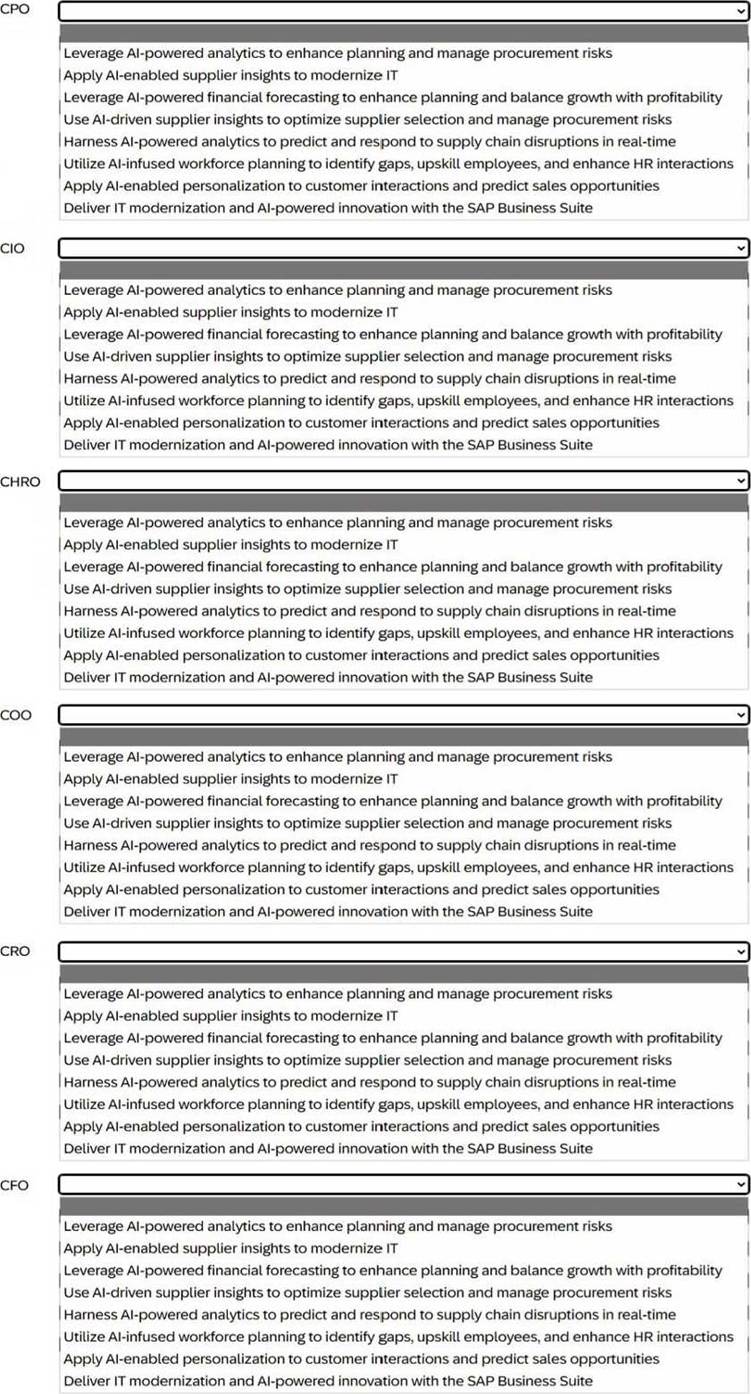
正解: 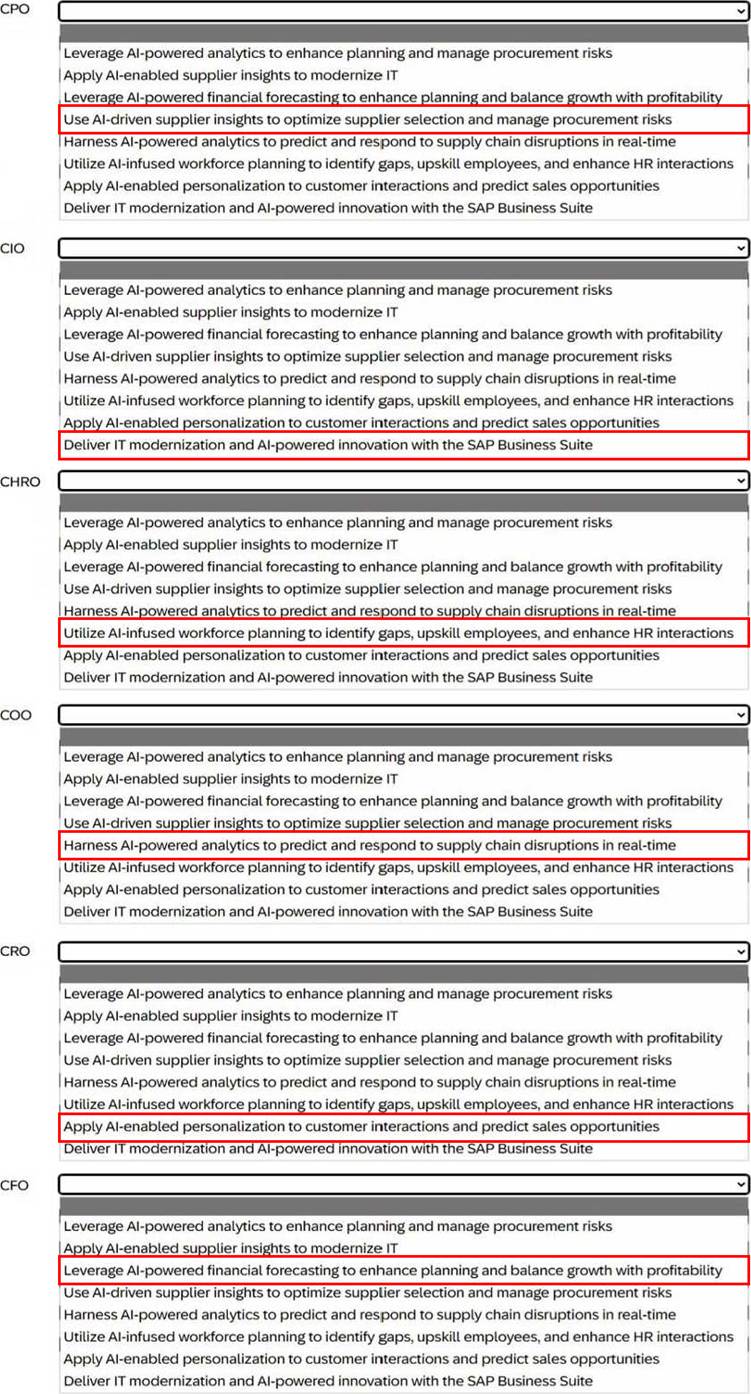
Explanation:
Step-by-Step Solution
Question No : 10
HOTSPOT
Match the outcomes in the dropdown lists to the capabilities of Joule
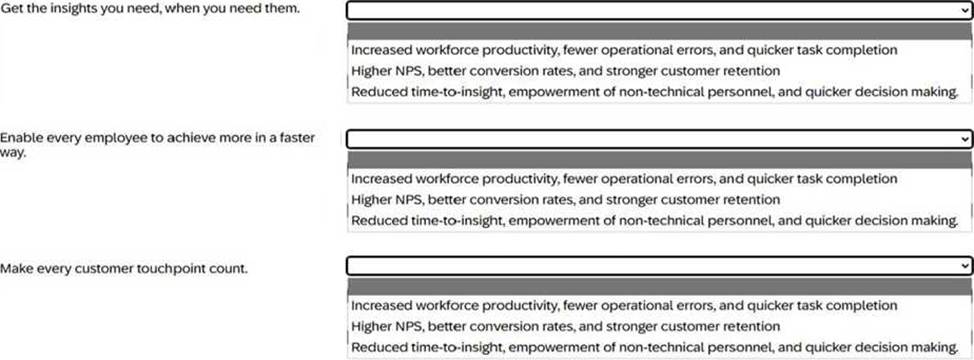
正解: 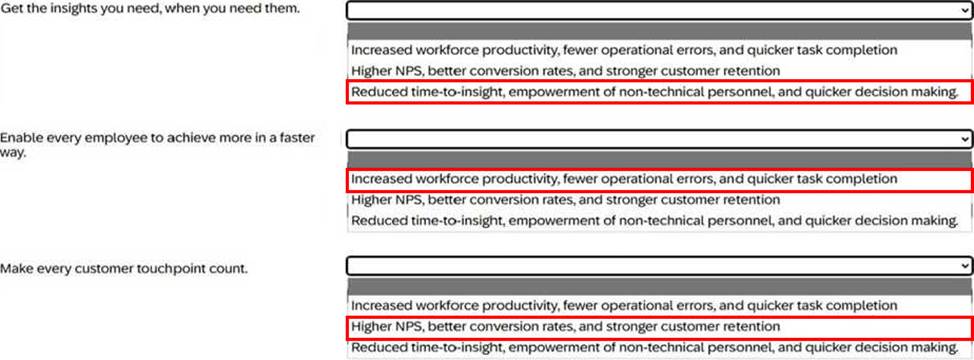
Explanation:
Step-by-Step Solution
Question No : 11
Which SAP module is specifically designed for supplier management and procurement processes? Please choose the correct answer.
正解:
Question No : 12
Which SAP Business Suite solutions support financial management and reporting? There are 3 correct answers to this question.
正解:
Question No : 13
Which SAP Business Suite component is primarily used for customer relationship management? Please choose the correct answer.
正解:
Question No : 14
How does SAP Business Suite improve decision-making for enterprises? Please choose the correct answer.
正解:
Question No : 15
How does SAP Business Suite facilitate digital transformation for enterprises? There are 2 correct answers to this question.
正解: