

毎月、GOWUKAKUは1500人以上の受験者が試験準備を助けて、試験に合格するために受験者にご協力します
SAP Certified Associate - Back-End Developer - ABAP Cloud 試験
最新更新時間: 2026/09/21
【秋学習応援セール|10月限定キャンペーン】:C_ABAPD_2309 最新真題を買う時、日本語版と英語版両方を同時に獲得できます。
実際の問題集を練習し、試験のポイントを了解し、テストに申し込むするかどうかを決めることができます。
さらに試験準備時間の35%を節約するには、C_ABAPD_2309 問題集を使用してください。
Question No : 1
What are advantages of using a field symbol for internal table row access? Note: There are answers to this question.
正解:
Explanation:
A field symbol is a pointer that allows direct access to a row of an internal table without copying it to a work area. Using a field symbol for internal table row access has some advantages over using a work area, such as12:
A MODIFY statement to write changed contents back to the table is not required: This is true. When you use a work area, you have to copy the row content from the internal table to the work area, modify it, and then copy it back to the internal table using the MODIFY statement. This can be costly in terms of performance and memory consumption. When you use a field symbol, you can modify the row content directly in the internal table without any copying. Therefore, you do not need the MODIFY statement12.
Using a field symbol is faster than using a work area: This is true. As explained above, using a field symbol avoids the overhead of copying data between the internal table and the work area. This can improve the performance of the loop considerably, especially for large internal tables. According to some benchmarks, using a field symbol can save 25C40% of the runtime compared to using a work area12.
You cannot do any of the following:
The field symbol can be reused for other programs: This is false. A field symbol is a local variable that is only visible within the scope of its declaration. It cannot be reused for other programs unless it is declared globally or passed as a parameter. Moreover, a field symbol must have the same type as the line type of the internal table that it accesses. Therefore, it cannot be used for any internal table with a different line type12.
The row content is copied to the field symbol instead to a work area: This is false. As explained above, using a field symbol does not copy the row content to the field symbol. Instead, the field symbol points to the memory address of the row in the internal table and allows direct access to it. Therefore, there is no copying involved when using a field symbol12.
Reference: 1: Using Field Symbols to Process Internal Tables - SAP Learning 2: Access to Internal Tables - ABAP Keyword Documentation - SAP Online Help
Question No : 2
In a RESTful Application Programming application, in which objects do you bind a CDS view to create a value help? Note: There are 3 correct answers to this question.
正解:
Explanation:
In a RESTful Application Programming (RAP) application, you can bind a CDS view to create a value help in the following objects:
Data model view: A data model view is a CDS view that defines the data structure and the associations of an entity in the RAP application. You can use the annotation @Consumption.valueHelpDefinition to bind a value help provider CDS view to an element of the data model view. The value help provider CDS view must contain the key fields of the value help entity and the fields that are displayed in the value help dialog. The value help annotation specifies the entity name, the element name, and optionally the additional binding conditions for the value help provider1.
Metadata Extension: A metadata extension is a CDS view that extends the metadata of another CDS view without changing its data structure. You can use the annotation @MetadataExtension.extendView to specify the target CDS view that you want to extend. You can then use the same annotation @Consumption.valueHelpDefinition to bind a value help provider CDS view to an element of the target CDS view. The metadata extension allows you to add value help definitions to existing CDS views without modifying them2.
Projection View: A projection view is a CDS view that defines the projection of another CDS view. You can use the annotation @AbapCatalog.sqlViewType: #PROJECTION to specify that the CDS view is a projection view. You can then use the same annotation @Consumption.valueHelpDefinition to bind a value help provider CDS view to an element of the projection view. The projection view allows you to add value help definitions to projected elements of another CDS view3.
You cannot bind a value help provider CDS view to a behavior definition or a service definition, because these objects do not define the data structure or the metadata of an entity in the RAP application. A behavior definition defines the behavior and the validation rules of an entity, such as the create, read, update, and delete (CRUD) operations, the draft handling, the authorization checks, and the side effects4. A service definition defines the service exposure and the service binding of an entity, such as the protocol, the version, the namespace, and the service name5.
Reference: 1: Value Help with Additional Binding | SAP Help Portal 2: Metadata Extensions - ABAP
Keyword Documentation 3: Projection Views - ABAP Keyword Documentation 4: Behavior Definition -
ABAP Keyword Documentation 5: Service Definition - ABAP Keyword Documentation
Question No : 3
What RESTful Application Programming object contains only the fields required for a particular app?
正解:
Explanation:
A projection view is a RESTful Application Programming object that contains only the fields required for a particular app. A projection view is a CDS view entity that defines a projection on an existing CDS view entity or CDS DDIC-based view. A projection view exposes a subset of the elements of the projected entity, which are relevant for a specific business service. A projection view can also define aliases, virtual elements, and annotations for the projected elements. A projection view is the top-most layer of a CDS data model and prepares data for a particular use case. A projection view can have different provider contracts depending on the type of service it supports, such as transactional query, analytical query, or transactional interface.
A database view is a CDS DDIC-based view that defines a join or union of database tables. A database view has an SQL view attached and can be accessed by Open SQL or native SQL. A database view can be used as a projected entity for a projection view, but it does not contain only the fields required for a particular app.
A metadata extension is a RESTful Application Programming object that defines additional annotations for a CDS view entity or a projection view. A metadata extension can be used to enhance the metadata of a CDS data model without changing the original definition. A metadata extension does not contain any fields, but only annotations.
A data model view is a CDS view entity that defines a data model based on database tables or other CDS view entities. A data model view can have associations, aggregations, filters, parameters, and annotations. A data model view can be used as a projected entity for a projection view, but it does
not contain only the fields required for a particular app.
Reference: CDS Projection Views - ABAP Keyword Documentation, CDS Projection Views in ABAP
CDS: What’s Your Flavor, Business Object Projection - ABAP Keyword Documentation
Question No : 4
Refer to the exhibit.
What are valid statements? Note: There are 2 correct answers to this question.
正解:
Explanation:
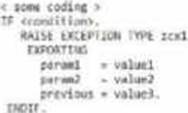
The code snippet in the image is an example of using the RAISE EXCEPTION statement to raise a class-based exception and create a corresponding exception object. The code snippet also uses the EXPORTING addition to pass parameters to the instance constructor of the exception class12. Some of the valid statements about the code snippet are:
The code creates an exception object and raises an exception: This is true. The RAISE EXCEPTION statement raises the exception linked to the exception class zcxl and generates a corresponding exception object. The exception object contains the information about the exception, such as the message, the source position, and the previous exception12.
“previous” expects the reference to a previous exception: This is true. The previous parameter is a predefined parameter of the instance constructor of the exception class cx_root, which is the root class of all class-based exceptions. The previous parameter expects the reference to a previous
exception object that was caught during exception handling. The previous parameter can be used to chain multiple exceptions and preserve the original cause of the exception12. You cannot do any of the following:
“zcxl” is a dictionary structure, and “paraml” and “param2” are this structure: This is false. zcxl is not a dictionary structure, but a user-defined exception class that inherits from the predefined exception class cx_static_check. param1 and param2 are not components of this structure, but input parameters of the instance constructor of the exception class zcxl. The input parameters can be used to pass additional information to the exception object, such as the values that caused the exception12.
“paraml” and “param2” are predefined names: This is false. param1 and param2 are not predefined names, but user-defined names that can be chosen arbitrarily. However, they must match the names of the input parameters of the instance constructor of the exception class zcxl. The names of the input parameters can be declared in the interface of the exception class using the RAISING addition12.
Explanation:
Reference: 1: RAISE EXCEPTION - ABAP Keyword Documentation - SAP Online Help 2: Class-Based Exceptions - ABAP Keyword Documentation - SAP Online Help
Question No : 5
In ABAP SQL, which of the following retrieves the association field_Airline-Name of a CDS view?
正解:
Explanation:
In ABAP SQL, the syntax to retrieve the association field of a CDS view is to use the @ sign followed by the association name and the field name, separated by a period sign (.). For example, to retrieve the association field _Airline-Name of a CDS view, the syntax is @_Airline.Name. This syntax allows the access to the fields of the target data source of the association without explicitly joining the data sources1. The other options are incorrect because they use the wrong symbols or formats to access the association field.
Reference: 1: Path Expressions - ABAP Keyword Documentation
Question No : 6
Which of the following ABAP SQL statements are valid? Note: There are 2 correct answers to this question.
正解:
Explanation:
The following are the explanations for each ABAP SQL statement:
A: This statement is valid. It selects the fields carrid, airpfrom, and the aggregate functions MAX(distance) and MIN(distance) from the table /dmo/connection, and groups the results by carrid and airpfrom. The aggregate functions are aliased as dist_max and dist_min. The results are stored in an internal table named It_hits, which is created using the inline declaration operator @DATA.
B: This statement is valid. It is similar to statement A, except that it does not specify the GROUP BY clause. This means that the aggregate functions are applied to the entire table, and the results are stored in an internal table named It_hits, which is created using the inline declaration operator @DATA.
C: This statement is invalid. It selects the aggregate functions MAX(distance) and MIN(distance) from the table /dmo/connection, but it does not specify any grouping or non-aggregate fields. This is not allowed in ABAP SQL, as the SELECT list must contain at least one non-aggregate field or a GROUP BY clause. The statement will cause a syntax error.
D: This statement is invalid. It selects the fields carrid and airpfrom from the table /dmo/connection, and groups the results by carrid and connid. However, the field connid is not included in the SELECT list, which is not allowed in ABAP SQL, as the GROUP BY clause must contain only fields that are also in the SELECT list. The statement will cause a syntax error.
Reference: SELECT - ABAP Keyword Documentation, GROUP BY - ABAP Keyword Documentation
Question No : 7
Exhibit:
Which of the following statements are correct? Note: There are 2 correct answers to this question.
正解:
Explanation:
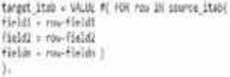
The code snippet in the image is an example of using the FOR statement to create an internal table with a constructor expression. The FOR statement introduces an iteration expression that runs over the content of source_itab and assigns each row to the variable row. The variable row is then used to populate the fields of target_itab12. Some of the correct statements about the code snippet are: FOR defines a loop that runs over the content of source_itab: This is true. The FOR statement iterates over the rows of source_itab and assigns each row to the variable row. The iteration expression can also specify a range or a condition for the loop12.
row is only visible within the loop: This is true. The variable row is a local variable that is only visible within the scope of the iteration expression. It cannot be accessed outside the loop12. You cannot do any of the following:
source_itab is only visible within the loop: This is false. The variable source_itab is not a local variable that is defined by the FOR statement. It is an existing internal table that is used as the data source for the iteration expression. It can be accessed outside the loop12.
row is a predefined name and cannot be chosen arbitrarily: This is false. The variable row is not a predefined name that is reserved by the FOR statement. It is a user-defined name that can be chosen arbitrarily. However, it must not conflict with any existing names in the program12.
Reference: 1: FOR - Iteration Expressions - ABAP Keyword Documentation - SAP Online Help 2: ABAP 7.4 Syntax - FOR Loop iteration | SAP Community
Question No : 8
What are some of the reasons that Core Data Services are preferable to the classical approach to data modeling? Note: There are 2 correct answers to this question.
正解:
Explanation:
Core Data Services (CDS) are preferable to the classical approach to data modeling for several reasons, but two of them are:
They implement code pushdown. Code pushdown is the principle of moving data-intensive logic from the application server to the database server, where the data resides. This reduces the data transfer between the application server and the database server, which improves the performance and scalability of the application. CDS enable code pushdown by allowing the definition of semantic data models and business logic in the database layer, using SQL and SQL-based expressions1.
They transfer computational results to the application server. CDS allow the application server to access the data and the logic defined in the database layer by using Open SQL statements. Open SQL is a standardized and simplified subset of SQL that can be used across different database platforms. Open SQL statements are translated into native SQL statements by the ABAP runtime environment and executed on the database server. The results of the computation are then transferred to the application server, where they can be further processed or displayed2.
Reference: 1: ABAP - Core Data Services (ABAP CDS) - ABAP Keyword Documentation 2: Open SQL - ABAP Keyword Documentation
Question No : 9
In an Access Control Object, which clauses are used? Note: There are 3 correct answers to this question.
正解:
Explanation:
An Access Control Object (ACO) is a CDS annotation that defines the access control rules for a CDS view entity. An ACO consists of one or more clauses that specify the role name, the data source, the access conditions, and the return code of the authority check12.
Some of the clauses that are used in an ACO are:
Where (to specify the access conditions): This clause is used to define the logical expression that
determines whether a user has access to the data source or not. The expression can use the fields of
the data source, the parameters of the CDS view entity, or the predefined variables $user and
$session. The expression can also use the functions check_authorization and check_role to perform
additional authority checks12.
Define role (to specify the role name): This clause is used to assign a name to the role that is defined by the ACO. The role name must be unique within the namespace of the CDS view entity and must not contain any special characters. The role name can be used to reference the ACO in other annotations, such as @AccessControl.authorizationCheck or @AccessControl.grant12.
Revoke (to remove access to the data source): This clause is used to explicitly deny access to the data source for a user who meets the conditions of the where clause. The revoke clause overrides any grant clause that might grant access to the same user. The revoke clause can be used to implement the principle of least privilege or to enforce data segregation12.
You cannot do any of the following:
Grant (to identify the data source): This is not a valid clause in an ACO. The grant clause is a separate annotation that is used to grant access to a CDS view entity or a data source for a user who has a specific role. The grant clause can reference an ACO by its role name to apply the access conditions defined by the ACO12.
Return code (to assign the return code of the authority check): This is not a valid clause in an ACO. The return code of the authority check is a predefined variable that is set by the system after performing the access control check. The return code can be used in the where clause of the ACO to specify different access conditions based on the outcome of the check12.
Reference: 1: Access Control Objects - ABAP Keyword Documentation - SAP Online Help 2: Access Control in Core Data Services (CDS) | SAP Help Portal
Question No : 10
Class super has subclass sub.
Which rules are valid for the sub constructor? Note: There are 2 correct answers to this question.
正解:
Explanation:
The sub constructor is the instance constructor of the subclass sub that inherits from the superclass super. The sub constructor has some rules that it must follow when it is defined and implemented12.
Some of the valid rules are:
The method signature can be changed: This is true. The sub constructor can have a different method signature than the super constructor, which means that it can have different input parameters, output parameters, or exceptions. However, the sub constructor must still call the super constructor with appropriate actual parameters that match its interface12.
The constructor of super must be called before using any components of your own instance: This is true. The sub constructor must ensure that the super constructor is called explicitly using super->constructor before accessing any instance components of its own class, such as attributes or methods. This is because the super constructor initializes the inherited components of the subclass and sets the self-reference me-> to the current instance12. You cannot do any of the following:
Import parameters can only be evaluated after calling the constructor of super: This is false. The sub constructor can evaluate its own import parameters before calling the constructor of super, as long as it does not access any instance components of its own class. For example, the sub constructor can use its import parameters to calculate some values or check some conditions that are needed for calling the super constructor12.
Events of your own instance cannot be raised before the registration of a handler in super: This is false. The sub constructor can raise events of its own instance before calling the constructor of super, as long as it does not access any instance components of its own class. For example, the sub constructor can raise an event to notify the consumers of the subclass about some status or error that occurred during the initialization of the subclass12.
Reference: 1: Inheritance and Constructors - ABAP Keyword Documentation - SAP Online
Help 2: Using Static and Instance constructor methods | SAP Blogs
Question No : 11
When does SAP recommend to use a sorted or a hashed table respectively? Note: There are 2 correct answers to this question.
正解:
Explanation:
Question No : 12
What is the purpose of a foreign key relationship between two tables in the ABAP Dictionary?
正解:
Explanation:
The purpose of a foreign key relationship between two tables in the ABAP Dictionary is to ensure the
integrity of data in the corresponding database tables. A foreign key relationship defines a logical link between a foreign key table and a check table, where the foreign key fields of the former are assigned to the primary key fields of the latter. This means that the values entered in the foreign key fields must exist in the check table, otherwise the system will reject the entry. This way, the foreign key relationship prevents the insertion of invalid or inconsistent data in the database tables.
A foreign key relationship also serves to document the relationship between the two tables in the ABAP Dictionary, but this is not its primary purpose. A foreign key relationship does not necessarily create a corresponding foreign key relationship in the database, as this depends on the database system and the settings of the ABAP Dictionary. Some database systems do not support foreign keys at all, while others require additional steps to activate them. Therefore, the foreign key relationship in the ABAP Dictionary is mainly a logical concept that is enforced by the ABAP runtime environment.
Reference: Foreign Keys (SAP Library - ABAP Dictionary), Foreign Keys (SAP Library - BC - ABAP Dictionary)
https://help.sap.com/doc/saphelp_snc70/7.0/en-US/cf/21ea77446011d189700000e8322d00/content.htm
Question No : 13
Which of the following are features of Core Data Services? Note: There are 3 correct answers to this question.
正解:
Explanation:
Core Data Services (CDS) is a framework for defining and consuming semantically rich data models in SAP HANA. CDS supports various features that enhance the capabilities of SQL and enable developers to create data models that are optimized for performance, readability, and extensibility12. Some of the features of CDS are:
Associations: Associations are a way of defining relationships between CDS entities, such as tables or views. Associations enable navigation and path expressions in CDS queries, which allow accessing data from related entities without explicit joins. Associations also support cardinality, referential constraints, and cascading options34.
Annotations: Annotations are a way of adding metadata to CDS entities or their elements, such as fields or parameters. Annotations provide additional information or instructions for the CDS compiler, the database, or the consumers of the CDS views. Annotations can be used for various purposes, such as defining access control, UI rendering, OData exposure, or search capabilities5 . Structured Query Language (SQL): SQL is the standard language for querying and manipulating data in relational databases. CDS is based on SQL and extends it with additional features and syntax. CDS supports SQL features such as joins, aggregations, filters, expressions, functions, and subqueries. CDS also supports SQL Script, which is a scripting language for stored procedures and functions in SAP HANA .
You cannot do any of the following:
Inheritance: Inheritance is not a feature of CDS. Inheritance is a concept in object-oriented programming that allows a class to inherit the properties and methods of another class. CDS does not support object-oriented programming or classes.
Delegation: Delegation is not a feature of CDS. Delegation is a concept in object-oriented programming that allows an object to delegate some of its responsibilities to another object. CDS does not support object-oriented programming or objects.
Reference: 1: Core Data Services (CDS) | CAPire 2: Core Data Services [CDS] in SAP S/4 HANA | SAP
Blogs 3: Associations in Core Data Services (CDS) | SAP Help Portal 4: [CDS DDL - Association - ABAP
Keyword Documentation - SAP Online Help] 5: [Annotations in Core Data Services (CDS) | SAP Help
Portal] : [CDS DDL - Annotation - ABAP Keyword Documentation - SAP Online Help] : [Structured
Query Language (SQL) | SAP Help Portal] : [CDS DDL - SQL Features - ABAP Keyword Documentation -
SAP Online Help] : [Object-Oriented Programming in ABAP | SAP Help Portal]
Question No : 14
Refer to the exhibit.
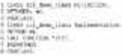
The class zcl_demo_class is in a software component with the language version set to "Standard ABAP". The function module "ZF11 is in a software component with the language version set to "ABAP Cloud". Both the class and function module are customer created. Regarding line #6, which of
the following is a valid statement?
正解:
Explanation:
The function module ZF1 is in a software component with the language version set to “ABAP Cloud”. This means that it follows the ABAP Cloud Development Model, which requires the usage of public SAP APIs and extension points to access SAP functionality and data. These APIs and extension points are released by SAP and documented in the SAP API Business Hub1. Customer-created function modules are not part of the public SAP APIs and are not released for cloud development. Therefore, calling a function module directly from a class with the language version set to “Standard ABAP” is not allowed and will result in a syntax error. However, there is a possible way to call a function module indirectly from a class with the language version set to “Standard ABAP”:
Create a wrapper class or interface for the function module and release it for cloud development. A wrapper is a class or interface that encapsulates the function module and exposes its functionality through public methods or attributes. The wrapper must be created in a software component with the language version set to “ABAP Cloud” and must be marked as released for cloud development using the annotation @EndUserText.label. The wrapper can then be called from a class with the language version set to “Standard ABAP” using the public methods or attributes2.
For example, the following code snippet shows how to create a wrapper class for the function module ZF1 and call it from the class zcl_demo_class:
@EndUserText.label: ‘Wrapper for ZF1’ CLASS zcl_wrapper_zf1 DEFINITION PUBLIC FINAL CREATE PUBLIC. PUBLIC SECTION. CLASS-METHODS: call_zf1 IMPORTING iv_a TYPE i iv_b TYPE i EXPORTING ev_result TYPE i. ENDCLASS.
CLASS zcl_wrapper_zf1 IMPLEMENTATION. METHOD call_zf1. CALL FUNCTION ‘ZF1’ EXPORTING a = iv_a b = iv_b IMPORTING result = ev_result. ENDMETHOD. ENDCLASS. CLASS zcl_demo_class DEFINITION. METHODS: m1. ENDCLASS.
CLASS zcl_demo_class IMPLEMENTATION. METHOD m1. DATA(lv_result) =
zcl_wrapper_zf1=>call_zf1( iv_a = 2 iv_b = 3 ). WRITE: / lv_result. ENDMETHOD. ENDCLASS.
The output of this code is: 5
Reference: 1: SAP API Business Hub 2: Creating an ABAP Cloud Project | SAP Help Portal
Question No : 15
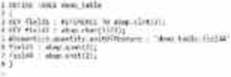
Which field is defined incorrectly?
正解:
Explanation:
The field4 is defined incorrectly in the ABAP code snippet. The reason is that the data type c (character) cannot have a decimal places specification. The decimal places specification is only valid for the data types p (packed number) and f (floating point number)1. Therefore, the field4 definition should either omit the decimal places specification or change the data type to p or f.
Explanation:
Reference: 1: Data Types and Data Objects - ABAP Keyword Documentation - SAP Online Help