

毎月、GOWUKAKUは1500人以上の受験者が試験準備を助けて、試験に合格するために受験者にご協力します
CCIE Collaboration 試験
最新更新時間: 2026/09/21
【秋学習応援セール|10月限定キャンペーン】:400-051 最新真題を買う時、日本語版と英語版両方を同時に獲得できます。
実際の問題集を練習し、試験のポイントを了解し、テストに申し込むするかどうかを決めることができます。
さらに試験準備時間の35%を節約するには、400-051 問題集を使用してください。
Question No : 1
Refer to the exhibit.
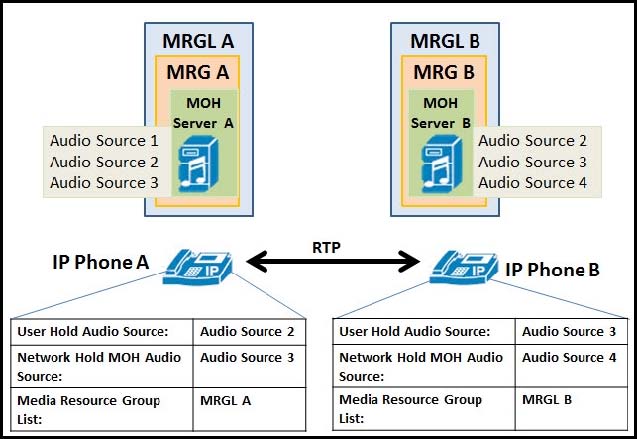
All displayed devices are registered to the same Cisco Unified Communications Manager server and the phones are engaged in an active call. Assuming the provided configurations exist at the phone line level and multicast MOH is disabled clusterwide, what will happen when the user of IP Phone B presses the Hold softkey?
A. IP Phone A receives audio source 2 from MOH Server A.
B. IP Phone A receives audio source 3 from MOH Server A.
C. IP Phone A receives audio source 2 from MOH Server B.
D. IP Phone A receives audio source 3 from MOH Server B.
E. IP Phone A receives audio source 1 from MOH Server A.
正解: B
Explanation:
Held parties determine the media resource group list that a Cisco Unified Communications Manager uses to allocate a music on hold resource.
Question No : 2
Which system location is used for intercluster Enhanced Location CAC on Cisco Unified Communications Manager?
正解:
Explanation:
The shadow location is used to enable a SIP trunk to pass Enhanced Location CAC information such as location name and Video-Traffic-Class (discussed below), among other things, required for Enhanced Location CAC to function between clusters. In order to pass this location information across clusters, the SIP intercluster trunk (ICT) must be assigned to the "shadow" location. The shadow location cannot have a link to other locations, and therefore no bandwidth can be reserved between the shadow location and other locations. Any device other than a SIP ICT that is assigned to the shadow location will be treated as if it was associated to Hub_None. That is important to know because if a device other than a SIP ICT ends up in the shadow location, bandwidth deductions will be made from that device as if it were in Hub_None, and that could have varying effects depending on the location and links configuration.
Question No : 3
When neither the active or standby Location Bandwidth Manager in the configured LBM group is available, what will the Cisco CallManager service on a subscriber Cisco Unified Communications Manager server do to make location CAC decisions?
正解:
Explanation:
By default the Cisco CallManager service communicates with the local LBM service; however, LBM groups can be used to manage this communication. LBM groups provide an active and standby LBM in order to create redundancy for Unified CM call control.
Question No : 4
What is the amount of audio bandwidth, in kilobits per second, that is used in the Cisco Unified Communications Manager location bandwidth calculation for a G.728 call?
正解:
Explanation:
G.728―Low-bit-rate codec that video endpoints support.It support kilobits per second
Question No : 5
Which configuration component in Cisco Unified Communications Manager Enhanced Location Call Admission Control is designated to participate directly in intercluster replication of location, links, and bandwidth allocation data?
正解:
Explanation:
A Location Bandwidth Manager (LBM) service that has been designated to participate directly in intercluster replication of fixed locations, links data, and dynamic bandwidth allocation data. LBMs assigned to an LBM hub group discover each other through their common connections and form a fully-meshed intercluster replication network. Other LBM services in a cluster with an LBM hub participate indirectly in intercluster replication through the LBM hubs in their cluster.
Question No : 6
Which statement about the effective path in the Enhanced Location Call Admission Control mechanism on Cisco Unified Communications Manager is true?
正解:
Explanation:
The effective path is the path used by Unified CM for the bandwidth calculations, and it has the least cumulative weight of all possible paths. Weights are used on links to provide a "cost" for the "effective path" and are pertinent only when there is more than one path between any two locations.
Question No : 7
What does a weight represent in the Enhanced Location Call Admission Control mechanism on Cisco Unified Communications Manager?
正解:
Explanation:
A weight provides the relative priority of a link in forming the effective path between any pair of locations. The effective path is the path used by Unified CM for the bandwidth calculations, and it has the least cumulative weight of all possible paths. Weights are used on links to provide a "cost" for the "effective path" and are pertinent only when there is more than one path between any two locations.
Question No : 8
What does a period accomplish when it is used in a SIP Dial Rule pattern that is associated with a Cisco 9971 IP Phone that is registered to Cisco Unified Communications Manager?
正解:
Explanation:
Asterisk (*) matches one or more characters. The * gets processed as a wildcard character. You can override this by preceding the * with a backward slash (\) escape sequence, which results in the sequence \*. The phone automatically strips the \, so it does not appear in the outgoing dial string. When * is received as a dial digit, it gets matched by the wildcard characters * and period (.).
Question No : 9
What does a comma accomplish when it is used in a SIP Dial Rule pattern that is associated with a Cisco 9971 IP Phone that is registered to Cisco Unified Communications Manager?
正解:
Explanation:
Comma is accepted in speed dial as delimiter and pause. -Comma used to delineate dial string, FAC, CMC, and post connect digits For post connect digits, commas insert a 2 second delay Commas may be duplicated to create longer delays.
Question No : 10
Refer to the exhibit.
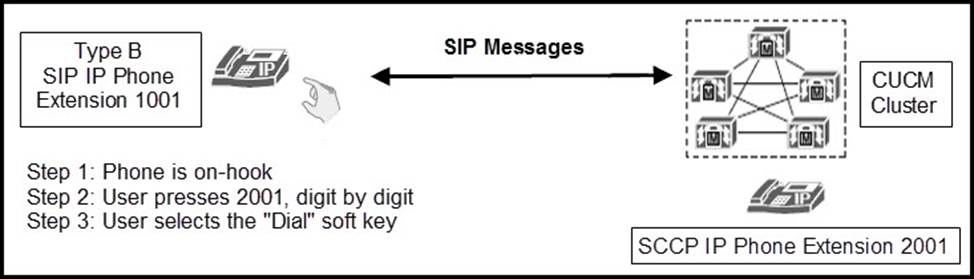
A user is going through a series of dialing steps on a SIP Type B IP phone (for example, a Cisco 7975) to call an SCCP IP phone. Both phones are registered to the same Cisco Unified Communications Manager cluster. Assuming the calling SIP phone is associated with a SIP Dial Rule with a pattern value of 2001, which statement about the call setup process of this call is true?
正解:
Explanation:
Cisco Type B SIP Phones offer functionality based SIP INVITE Message. Every key the end user presses triggers an individual SIP message. The first event is communicated with a SIP INVITE, but subsequent messages use SIP NOTIFY messages. The SIP NOTIFY messages send KPML events corresponding to any buttons or soft keys pressed by the user. Cisco Type B SIP IP Phones with SIP dial rules operate in the same manner as Cisco Type A phones with dial rules.
Question No : 11
Refer to the exhibit.
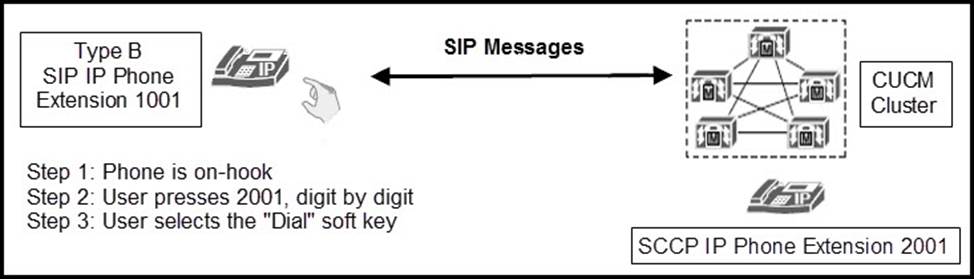
A user is going through a series of dialing steps on a SIP Type B IP phone (for example, a Cisco 7975) to call an SCCP IP phone. Both phones are registered to the same Cisco Unified Communications Manager cluster. Assuming the calling SIP phone is associated with a SIP dial rule with a pattern value of 2001, which statement about how digits are forwarded to Cisco Unified Communications Manager for further call processing is true?
正解:
Explanation:
Cisco Type B SIP Phones offer functionality based SIP INVITE Message. Every key the end user presses triggers an individual SIP message. The first event is communicated with a SIP INVITE, but subsequent messages use SIP NOTIFY messages. The SIP NOTIFY messages send KPML events corresponding to any buttons or soft keys pressed by the user. Cisco Type B SIP IP Phones with SIP dial rules operate in the same manner as Cisco Type A phones with dial rules.
Question No : 12
Refer to the exhibit.
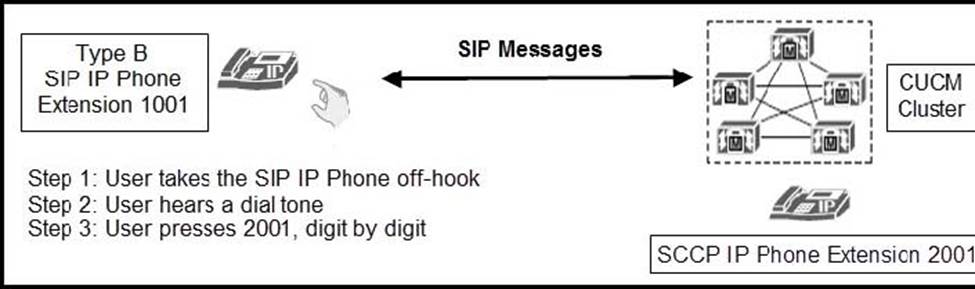
A user is going through a series of dialing steps on a SIP Type B IP phone (for example, a Cisco 7975) to call an SCCP IP phone. Both phones are registered to the same Cisco Unified Communications Manager cluster. Assuming that the calling SIP phone is not associated with any SIP dial rules, which statement about how digits are forwarded to Cisco Unified Communications Manager for further call processing is true?
正解:
Explanation:
KPML procedures use a SIP SUBSCRIBE message to register for DTMF digits. The digits themselves are delivered in NOTIFY messages containing an XML encoded body. And it is Out of Band DTMF
Question No : 13
According to ITU-T E.164 recommendations, which two fields in the National Significant Number code may be further subdivided? (Choose two.)
正解:
Explanation:
A telephone number can have a maximum of 15 digits .The first part of the telephone number is the country code (one to three digits) .The second part is the national destination code (NDC). The last part is the subscriber number (SN). The NDC and SN together are collectively called the national (significant) number.
Question No : 14
What is the maximum length of any numeric geographic area address in ITU recommendation E.164?
正解:
Explanation:
E.164 defines a general format for international telephone numbers. Plan-conforming numbers are limited to a maximum of 15 digits. The presentation of numbers is usually prefixed with the character + (plus sign), indicating that the number includes the international country calling code (country code), and must typically be prefixed when dialing with the appropriate international call prefix, which is a trunk code to reach an international circuit from within the country of call origination.
Question No : 15
Which device is the initiator of a StationD message in a Cisco Unified Communications Manager SDI trace?
正解:
Explanation:
All messages to and from a skinny device are preceded by either the words StationD or StationInit. StationD messages are sent from call manager to IP phone. Skinny message transmission such as this
between the IP phone and CallManger occurs for every action undertaken by the IP phone, includinginitialization, registration, on-hook, off-hook, dialing of the digits, key press on the phone, and so much more.