

毎月、GOWUKAKUは1500人以上の受験者が試験準備を助けて、試験に合格するために受験者にご協力します
Implementing and Operating Cisco Service Provider Network Core Technologies (SPCOR) 試験
最新更新時間: 2026/09/21
【秋学習応援セール|10月限定キャンペーン】:350-501 最新真題を買う時、日本語版と英語版両方を同時に獲得できます。
実際の問題集を練習し、試験のポイントを了解し、テストに申し込むするかどうかを決めることができます。
さらに試験準備時間の35%を節約するには、350-501 問題集を使用してください。
Question No : 1
Refer to the exhibit.
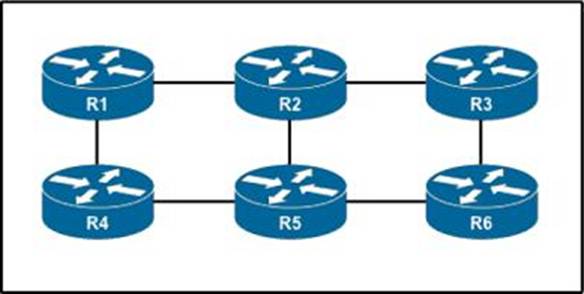
An engineer is configuring an administrative domain in the given multi-vendor environment with PIM-SM.
Which feature must the engineer implement so that devices will dynamically learn the RP?
正解:
Explanation:
In a multi-vendor environment with PIM-SM, the Bootstrap Router (BSR) mechanism is used for devices to dynamically learn the Rendezvous Point (RP). BSR is a protocol feature that automates the dissemination of RP information in a PIM domain. This feature allows routers to automatically discover the RP set in use, which simplifies configuration and management compared to static RP configurations or Auto-RP.
Reference: Implementing and Operating Cisco Service Provider Network Core Technologies source documents or study guide
Question No : 2
Refer to the exhibit.
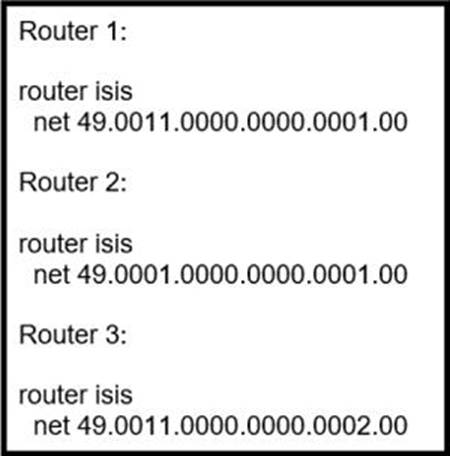
Router 4 is added to the network and must be in the same area as router 1.
Which NET should the engineer assign?
正解:
Explanation:
Router 4 must be in the same area as Router 1, so it should have the same area address which is “49.0111”. The system ID can be different to uniquely identify the router in that area, but since there is no option with a different system ID and the same area address, option B is correct as it has both the same area address and system ID as Router 1.
Reference: = Cisco
Question No : 3
DRAG DROP
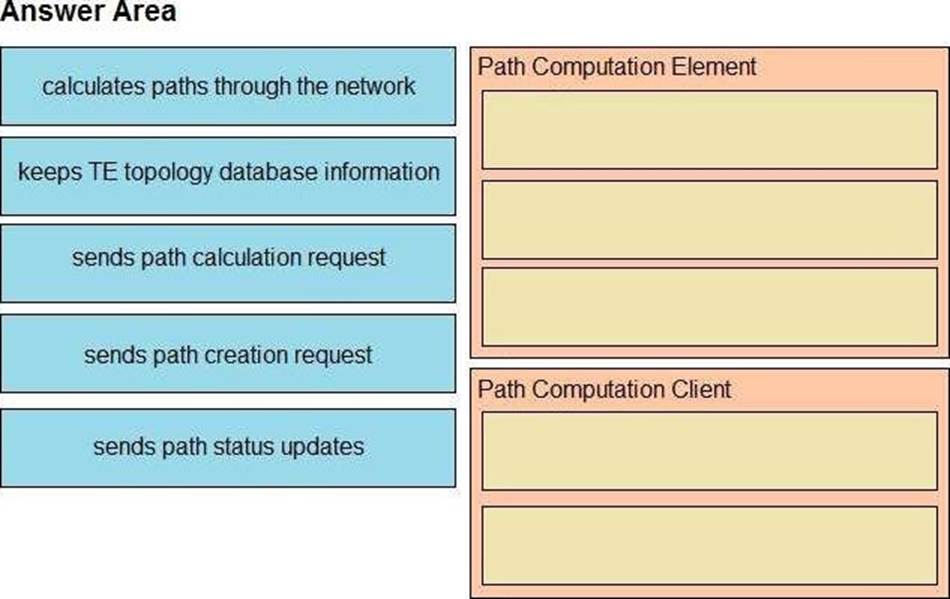
Drag and drop the functions from the left onto the Path Computation Element Protocol roles on the right.
正解: 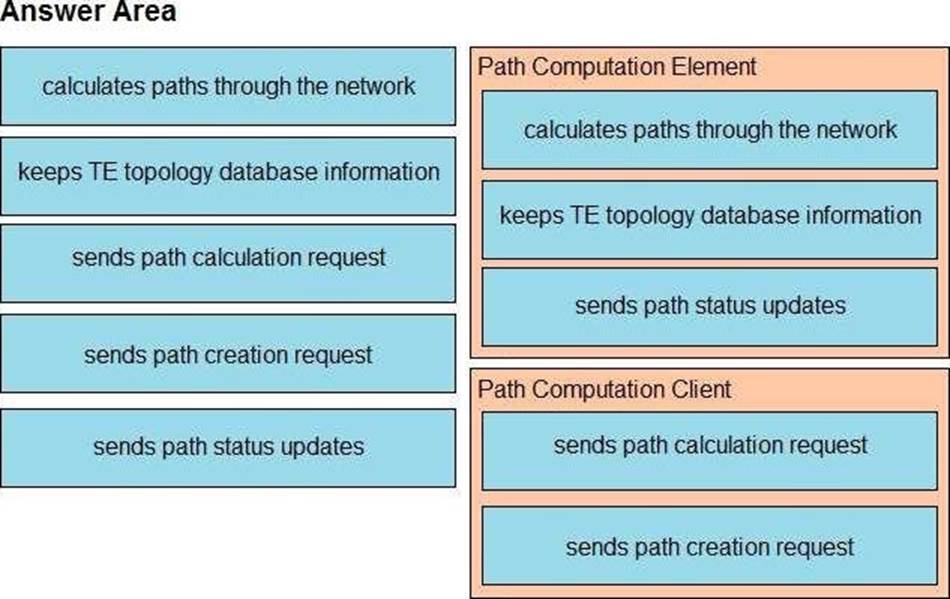
Explanation:
PCE C 1,2,5
PCC- 3,4
Question No : 4
Refer to the exhibit.

What does the number 2 mean in the configuration?
正解:
Explanation:
The number “2” in the SNMP server configuration “snmp-server community ciscotest ro 2” refers to the numeric name of the Access Control List (ACL) that contains the list of SNMP managers with access to the agent. In this context, “ro” stands for read-only access, meaning that SNMP managers can only read but not modify data on the device. The ACL identified by number “2” specifies which SNMP managers are authorized to access SNMP data on this device using the community string “ciscotest”.
Reference: Implementing and Operating Cisco Service Provider Network Core Technologies source documents or study guide.
Question No : 5
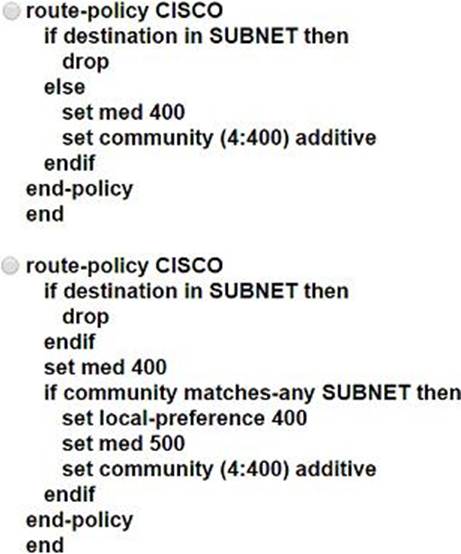
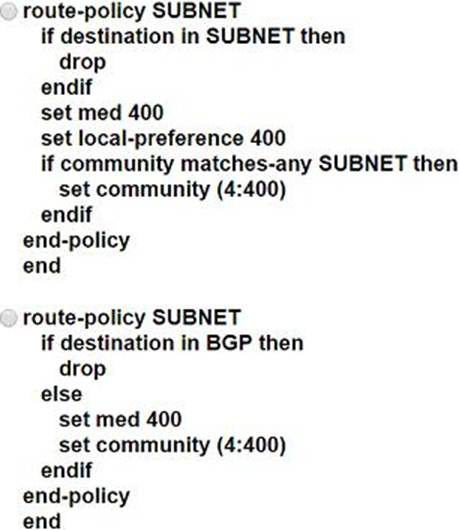
A network engineer is configuring a BGP route policy for the SUBNET prefix set. Matching traffic must be dropped, and other traffic must have its MED value set to 400 and community 4:400 added to the route.
Which configuration must an engineer apply?
正解:
Explanation:
The correct configuration for the BGP route policy named SUBNET, as per the second set of text in the image details, is to drop traffic if the destination is in BGP. Otherwise, the MED value should be set to 400 and community (4:400) should be added. This matches Option B, which specifies these exact actions.
Reference: = The information is based on the image details provided and aligns with common BGP route policy configurations typically found in Cisco’s service provider network core technologies documentation.
Question No : 6
Refer to the exhibit.
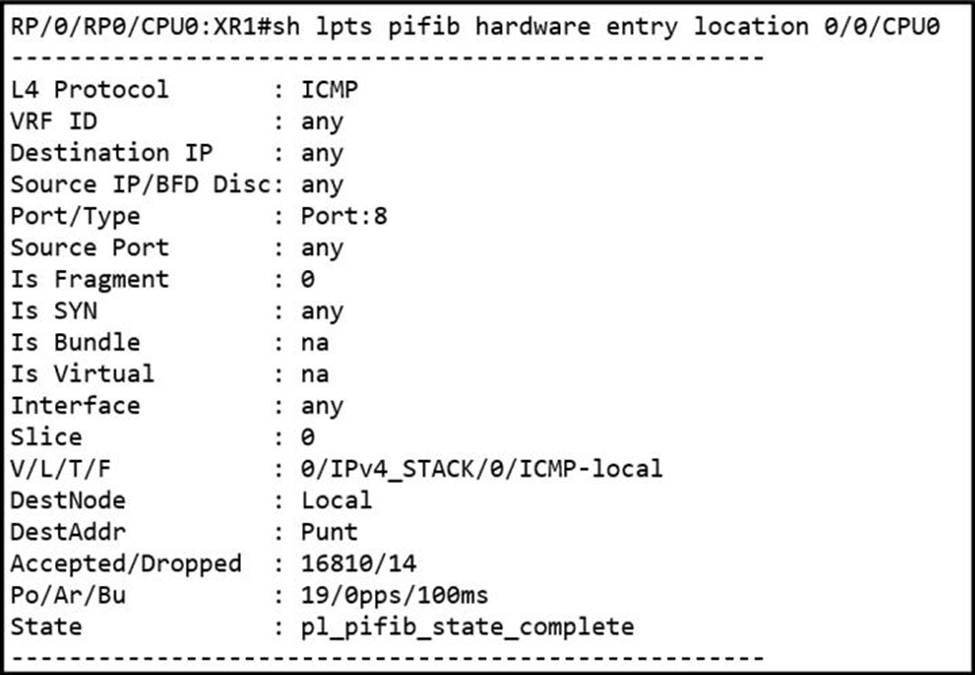
While troubleshooting the network, a network operator with an employee id: 3812:12:993 is trying to ping XR1.
Which result should the operator expect when trying to ping to an XR1 local address?
正解:
Explanation:
https://www.cisco.com/c/en/us/td/docs/routers/asr9000/software/asr9k-r6-5/ip-addresses/configuration/guide/b-ip-addresses-cg-asr9000-65x/m-implementing-lpts-asr9000-crs.html
Question No : 7
Refer to the exhibit.
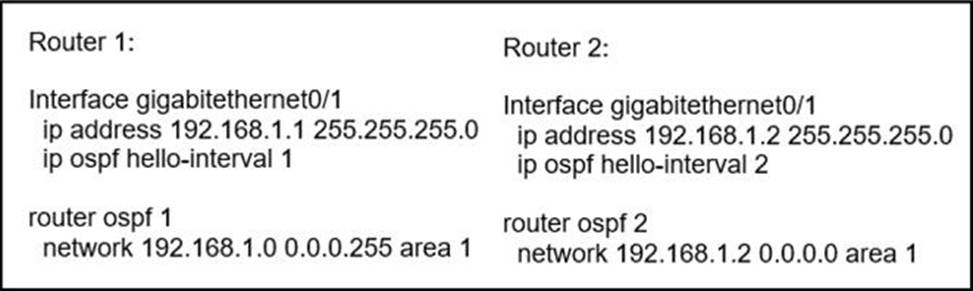
What reestablishes the OSPF neighbor relationship between Router 1 and Router 2?
正解:
Explanation:
In OSPF (Open Shortest Path First), the Hello interval is a critical parameter for OSPF neighbor formation. It defines the frequency at which Hello packets are sent on an OSPF interface. For two OSPF routers to become neighbors, they must have matching Hello and Dead intervals. In the provided configuration, Router 1 has a hello-interval of 1 second while Router 2 has a hello-interval of 2 seconds. Adjusting them to match will reestablish the OSPF neighbor relationship between Router 1 and Router 2.
Reference: Implementing and Operating Cisco Service Provider Network Core Technologies (SPCOR) - Cisco
Question No : 8
Refer to the exhibit.
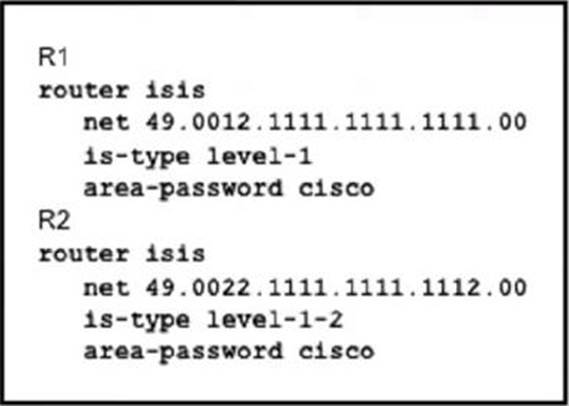
What is the effect of this configuration?
正解:
Explanation:
The configuration shown indicates that R1 has been configured to support Label Distribution Protocol (LDP) graceful restart. This means that R1 will maintain the forwarding state during an LDP restart, allowing it to continue forwarding packets along known routes while it re-establishes LDP neighbors/peers. This ensures minimal disruption to traffic flow during such events.
Reference: Implementing and Operating Cisco Service Provider Network Core Technologies source documents or study guide
Question No : 9
Which protocol does a Cisco MPLS TE tunnel use to maintain paths within the core?
正解:
Explanation:
RSVP (Resource Reservation Protocol) is used in MPLS Traffic Engineering (TE) tunnels to establish and maintain paths within the core network. It helps in reserving resources across an IP network and plays a crucial role in ensuring that the network can handle the traffic load efficiently, providing optimal data transfer paths while maximizing network resource utilization and quality of service.
Reference: Implementing and Operating Cisco Service Provider Network Core Technologies source documents or study guide
Question No : 10
Refer to the exhibit.
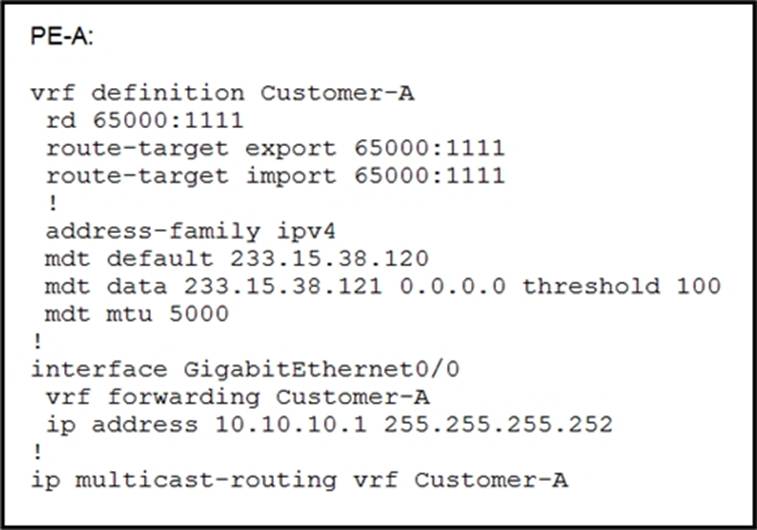
An engineer is implementing Auto-RP and reviewing the configuration of the PE-A.
Which configuration permits Auto-RP messages to be forwarded over this interface?
A. PE-A(config-if)#ip pim sparse-mode
B. PE-A(config-if)#no ip pim bsr-border
C. PE-A(config-if)#ip igmp version 3
D. PE-A(config-if)#ip pim sparse-dense-mode
正解: D
Explanation:
Option D is the correct answer because, in the context of Auto-RP, sparse-dense mode allows the router to forward Auto-RP messages. Auto-RP uses dense mode multicast groups (224.0.1.39 and 224.0.1.40) to advertise RP mapping information, so enabling sparse-dense mode on the interface ensures that it can process both types of multicast traffic.
Reference: Implementing and Operating Cisco Service Provider Network Core Technologies (SPCOR) official course materials, which can be found here.
Question No : 11
What does DWDM use to combine multiple optical signals?
正解:
Explanation:
DWDM, or Dense Wavelength Division Multiplexing, uses different wavelengths of light to combine multiple optical signals. This method allows for the transmission of various data streams simultaneously over a single optical fiber. By using closely spaced wavelengths, DWDM can fit more channels onto a single fiber, significantly increasing the capacity and efficiency of fiber-optic networks.
Reference: The explanation is based on the information available from the web search results on DWDM, which aligns with the principles outlined in the Cisco Service Provider source book.
Question No : 12
Refer to the exhibit.
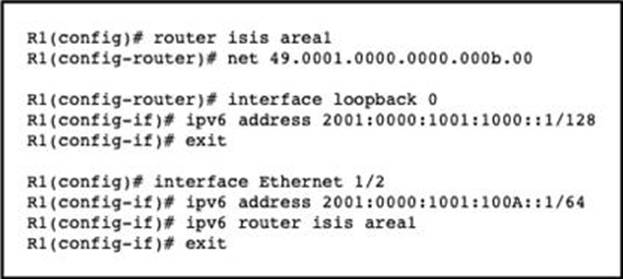
A network engineer with an employee id: 3812:12:993 has started to configure router R1 for IS-IS as shown.
Which additional configuration must be applied to configure the IS-IS instance to advertise only network prefixes associated to passive interfaces?
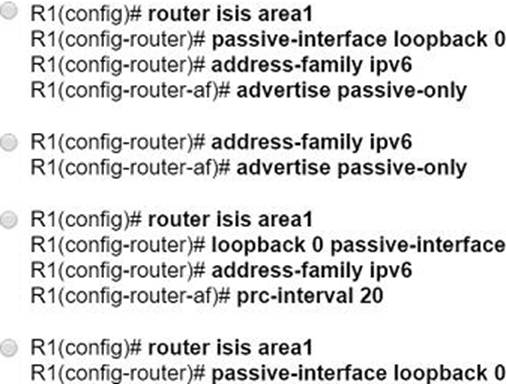
正解:
Explanation:
In IS-IS, to advertise only the network prefixes associated with passive interfaces, the command advertise passive-only under the address family configuration mode is used. This ensures that only the prefixes of passive interfaces are advertised to other IS-IS routers in the network. The passive interface command is used to prevent IS-IS from forming adjacencies over that interface, while still allowing the network prefix of the interface to be included in the IS-IS link-state database.
Reference: For a comprehensive understanding, refer to the “Implementing and Operating Cisco Service Provider Network Core Technologies (SPCOR)” source book and study guide
Question No : 13
Which utility must be used to locate MPLS faults?
正解:
Explanation:
The MPLS LSP ping is the utility that must be used to locate MPLS faults. It is specifically designed to troubleshoot Multiprotocol Label Switching (MPLS) by sending a ping through the MPLS network to verify the path and identify any issues.
Reference: Cisco provides a guide on MPLS Troubleshooting
Question No : 14
What is a role of NSO?
正解:
Explanation:
NSO, or Network Services Orchestrator, provides full lifecycle management of devices and services in a network. It is designed to automate the service lifecycle from design and creation through deployment and decommissioning, without the need for manual intervention. This includes configuration, activation, updating, and ultimately, removal of services.
Reference: The role of NSO is detailed in the Cisco Crosswork Network Services Orchestrator (NSO) documentation
Question No : 15
Refer to the exhibit.
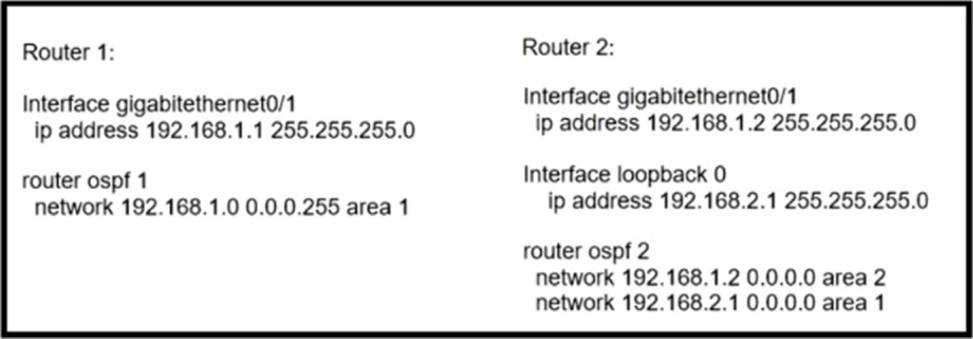
Router 1 is missing the route for the router 2 loopback 0.
What should the engineer change to fix the problem?
正解:
Explanation:
The issue with Router 1 missing the route for Router 2’s loopback 0 is likely due to the routers being configured in different OSPF areas. For OSPF to properly exchange routing information, routers within the same network should be configured in the same area. Therefore, the engineer should change the area numbers on Router 1 and Router 2 to be the same, ensuring they can exchange routes, including the route for Router 2’s loopback 0.
Reference: Implementing and Operating Cisco Service Provider Network Core Technologies (SPCOR) documentation and study materials.