

毎月、GOWUKAKUは1500人以上の受験者が試験準備を助けて、試験に合格するために受験者にご協力します
Implementing Cisco Application Centric Infrastructure - Advanced (DCACIA) 試験
最新更新時間: 2026/09/21
【秋学習応援セール|10月限定キャンペーン】:300-630 最新真題を買う時、日本語版と英語版両方を同時に獲得できます。
実際の問題集を練習し、試験のポイントを了解し、テストに申し込むするかどうかを決めることができます。
さらに試験準備時間の35%を節約するには、300-630 問題集を使用してください。
Question No : 1
How is broadcast forwarded in Cisco ACI Multi-Pod after ARP flooding is enabled?
正解:
Explanation:
In Cisco ACI Multi-Pod, when ARP flooding is enabled, broadcast traffic within a bridge domain is managed by associating a multicast address to the bridge domain. The broadcast frames are then forwarded within the pod and across the Inter-Pod Network (IPN) using this multicast address.
Reference: = Implementing Cisco Application Centric Infrastructure Official Cert Guide
Question No : 2
An engineer designs a Cisco ACI Multi-Pod solution that requires a pair of active-standby firewalls in different pods for external connectivity.
How should the firewalls be implemented?
正解:
Explanation:
In a Cisco ACI Multi-Pod design, having separate Layer 3 Out (L3Out) connections for each pod is recommended when implementing active-standby firewalls in different pods. This setup allows for independent routing and failover mechanisms, ensuring that each pod can maintain external connectivity even if one firewall fails.
Reference: = Implementing Cisco Application Centric Infrastructure Official Cert Guide
Reference: https://www.cisco.com/c/en/us/solutions/collateral/data-center-virtualization/application-centric-infrastructure/white-paper-c11-739571.html
Question No : 3
An organization expands a Cisco ACI Multi-Pod from two to six pods and must ensure that the control plane scales.
What should be configured in the IPN to ensure that BUM traffic is forwarded efficiently across the IPN?
正解:
Explanation:
In a Cisco ACI Multi-Pod environment that is expanding, spine headend replication should be configured to ensure efficient forwarding of BUM (Broadcast, Unknown unicast, Multicast) traffic across the IPN (Inter-Pod Network). This configuration optimizes the control plane scaling and ensures that BUM traffic is handled effectively, maintaining network performance and stability.
Reference: Implementing Cisco Application Centric Infrastructure Official Cert Guide
Question No : 4
An engineer must allow routes learned from one L3Out to be advertised out another L3Out. The engineer does not have an explicit list of all the routes that must be advertised out, however, they know that they are all part of the 10.16.0.0/16 CIDR block.
Which attributes must be selected under Ext-EPG to allow the necessary routes to be advertised out?
正解:
Explanation:
When allowing routes learned from one L3Out to be advertised out another L3Out, the Export Route Control Subnet should be enabled, and Aggregate Export should also be enabled. This configuration allows the necessary routes within the specified CIDR block to be aggregated and advertised out, facilitating efficient route advertisement without the need for an explicit list of all routes.
Reference: Implementing Cisco Application Centric Infrastructure Official Cert Guide
Question No : 5
As part of a newly deployed ACI fabric, a pair of border leaf switches have been deployed to provide shared services for all tenants. The configured L3Out runs OSPF as the routing protocol. The requirement is to advertise the routes from the border leaf switches to the compute leaf switches.
Which configuration must be implemented to meet these requirements?
正解:
Explanation:
To advertise routes from border leaf switches to compute leaf switches in a shared services scenario, the shared L3Out should be defined in the common tenant. This allows all tenants to access the shared services provided by the L3Out. By configuring the L3Out in the common tenant, routes can be advertised to the compute leaf switches, ensuring that the services are available across the ACI fabric.
Reference: Implementing Cisco Application Centric Infrastructure Official Cert Guide
Question No : 6
A customer is deploying a new application across two ACI pods that is sensitive to latency and jitter. The application sets the DSCP values of packets to AF31 and CS6, respectively.
Which configuration changes must be made on the APIC to support the new application and prevent packets from being delayed or dropped between pods?
正解:
Explanation:
To support an application that is sensitive to latency and jitter, it is crucial to ensure that the Quality of Service (QoS) levels within the ACI fabric and the Inter-Pod Network (IPN) QoS policies are aligned. This alignment will help in maintaining consistent handling of the DSCP values set by the application (AF31 and CS6) as the packets traverse across the two ACI pods. By aligning the QoS levels and policies, the application’s packets are less likely to experience delays or drops, thus preserving the required performance levels for the application’s optimal functionality.
Question No : 7
Refer to the exhibit.
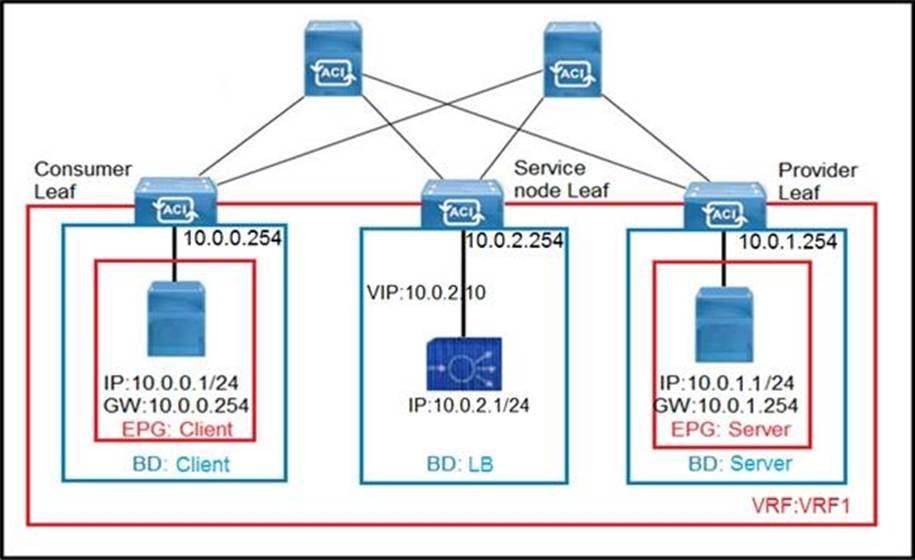
The client endpoint uses the load-balancer VIP as the destination address to send traffic to the server endpoint. If the load balancer does not do source NAT, which set of configurations must be applied on Cisco ACI to allow only the return traffic to be redirected to the service node?
正解:
Explanation:
To allow only the return traffic to be redirected to the service node when the load balancer does not perform source NAT, we need to configure a Policy-Based Redirect (PBR).
Here’s how it can be achieved:
Create a Contract:
Create a contract linked to the common/default filter. This contract will define the communication rules between the client endpoint and the server endpoint.
Configure L4-L7 Device:
Create an L4-L7 device with the function type set to “GoThrough.” This device will be used to redirect traffic to the service node.
Create a Policy-Based Redirect Policy:
Set up a Policy-Based Redirect (PBR) policy.
Specify the L3 Destination as the load balancer’s inside IP/MAC address.
Ensure that the L4-L7 Policy-Based Redirect Policy has the “GoThrough” function type.
Create a Service Graph Template:
Define a service graph template that references the previously created contract and L4-L7 device. Apply the service graph template to the relevant connectors. Connector Configuration:
On the consumer connector, reference the L4-L7 Policy-Based Redirect Policy.
On the provider connector, also reference the L4-L7 Policy-Based Redirect Policy.
By following this configuration, only the return traffic (from the server to the client) will be redirected to the service node, ensuring proper load balancing and traffic management.
Reference: Implementing Cisco Application Centric Infrastructure Official Cert Guide
Question No : 8
An engineer created a Cisco ACI environment in which multiple tenants reuse the same contract. The requirement is to prevent inter-tenant communication.
Which action meets this requirement?
正解:
Explanation:
To prevent inter-tenant communication while reusing the same contract, the contract should be
created in the user tenant with the scope set to VRF and then exported to other tenants. This approach allows the contract to be shared across tenants while maintaining the isolation of each tenant’s VRF. By setting the scope to VRF, the contract’s policies apply only within the context of the specified VRF, thus preventing communication between tenants5678.
Reference: = Implementing Cisco Application Centric Infrastructure Official Cert Guide
Question No : 9
Which feature should be disabled on a bridge domain when a default gateway for endpoints is on an external device instead of a Cisco ACI bridge domain SVI?
正解:
Explanation:
ARP flooding should be disabled on a bridge domain when the default gateway for endpoints is on an external device instead of a Cisco ACI bridge domain SVI. This is because ARP flooding allows for the resolution of IP addresses to MAC addresses within the bridge domain. When the default gateway is external, enabling ARP flooding can lead to unnecessary broadcast traffic on the network, as the ARP requests will not be contained within the ACI fabric. Disabling ARP flooding ensures that ARP requests are handled by the external device serving as the default gateway1234.
Reference: = Implementing Cisco Application Centric Infrastructure Official Cert Guide
Question No : 10
Refer to the exhibit.
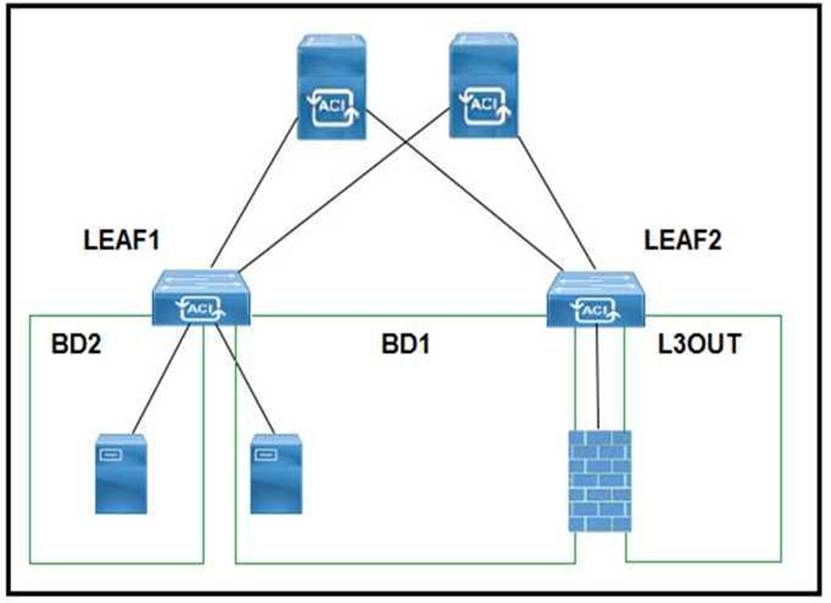
A customer experiences resource overconsumption on one of its border leaf switches.
Which action should be taken to reduce the consumption on this switch?
正解:
Explanation:
To address resource overconsumption on a border leaf switch, migrating L3Outs to another switch can help distribute the load and reduce strain on the affected switch.
Reference: = Implementing Cisco Application Centric Infrastructure Official Cert Guide
Question No : 11
A cloud provider must make a pair of firewalls available to all tenants. Each tenant defines its own service graph.
Where should the Layer 4 to Layer 7 service be configured to accomplish this goal?
正解:
Explanation:
In Cisco ACI, shared services like firewalls should be configured in the common tenant. This allows all tenants to access the services without duplicating them in each tenant.
Question No : 12
Refer to the exhibit.
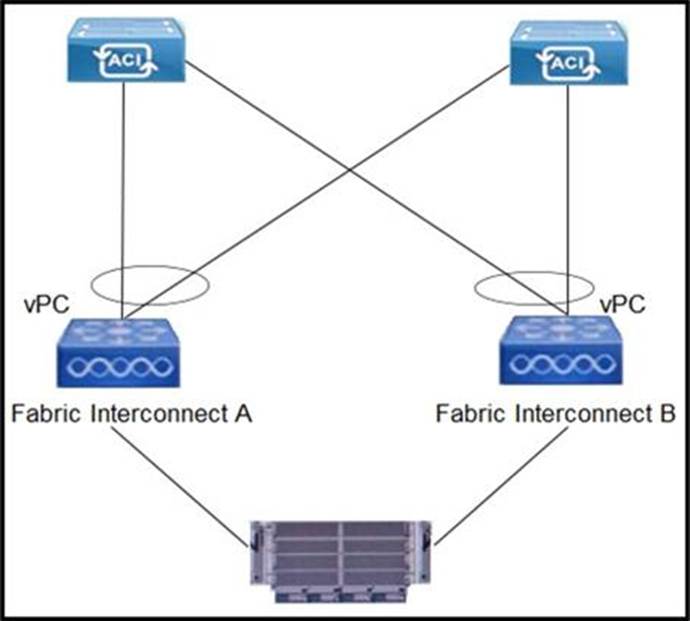
Which configuration mode must be selected for the VMM vSwitch Port Channel policy to avoid MAC flapping on the Cisco UCS Fls and Cisco ACI leaf switches?
正解:
Explanation:
To prevent MAC flapping on Cisco UCS Fabric Interconnects and ACI leaf switches, MAC Pinning should be selected for the VMM vSwitch Port Channel policy. This ensures consistent uplink usage for each virtual machine’s traffic, avoiding MAC address movement across multiple uplinks.
Reference: = Implementing Cisco Application Centric Infrastructure Official Cert Guide
Question No : 13
Refer to the exhibit.
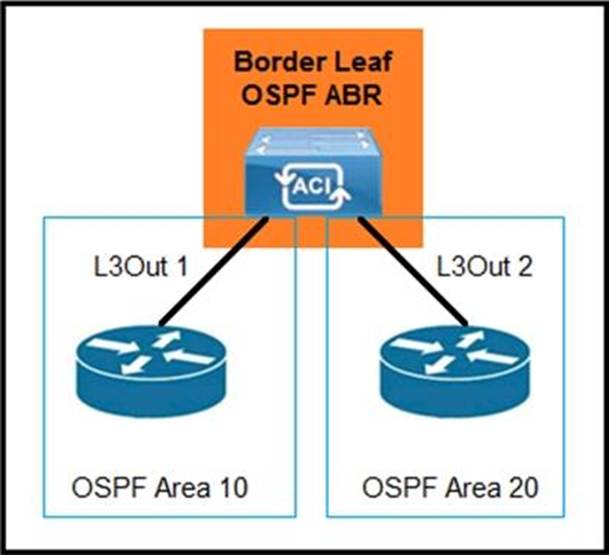
Which configuration must be implemented to allow intra-VRF transit routing between the two external routers?
正解:
Explanation:
For intra-VRF transit routing between two external routers in different OSPF areas, OSPF virtual links are required. They connect non-contiguous areas to the backbone area, ensuring all areas can communicate even if not directly connected.
Reference: = Implementing Cisco Application Centric Infrastructure Official Cert Guide
Question No : 14
Refer to the exhibit.
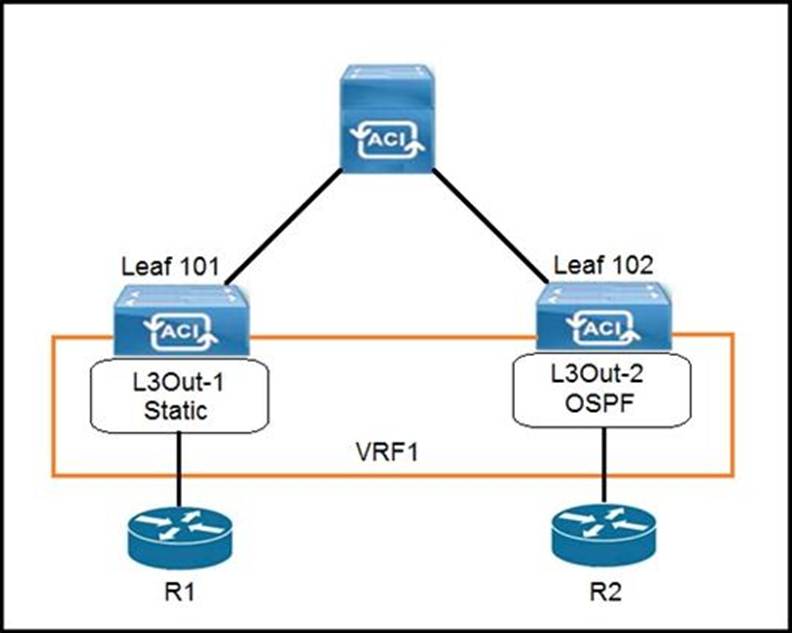
The 0.0.0.0/0 is configured as a default static route on L3Out-1.
Which action should be taken for the 0.0.0.0/0 prefix to advertise out on L3Out-2 OSPF?
正解:
Explanation:
In an ACI setup, to advertise a default static route from L3Out-1 to another L3Out using OSPF, the Aggregate Export Subnet feature must be enabled. This allows for the summarization and advertisement of routes, including the default route, to external networks via OSPF.
Reference: = Implementing Cisco Application Centric Infrastructure Official Cert Guide
Question No : 15
Refer to the exhibit.
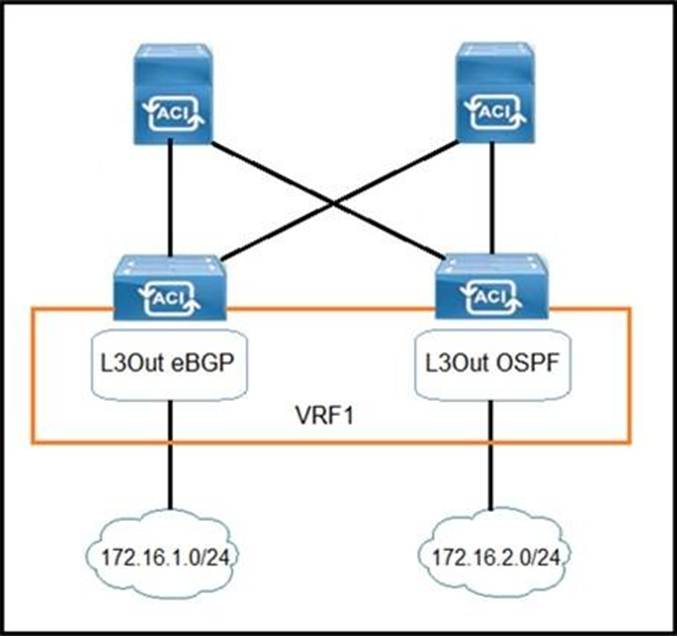
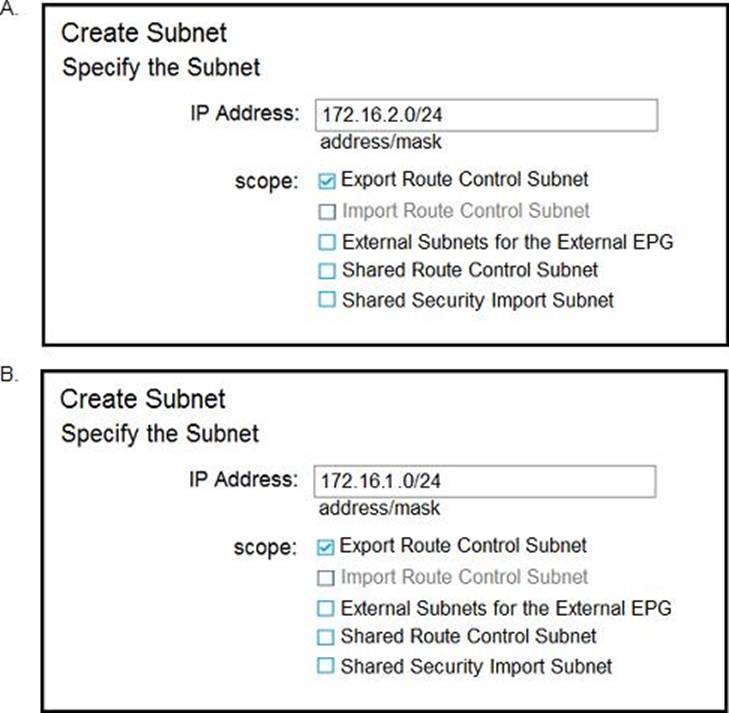
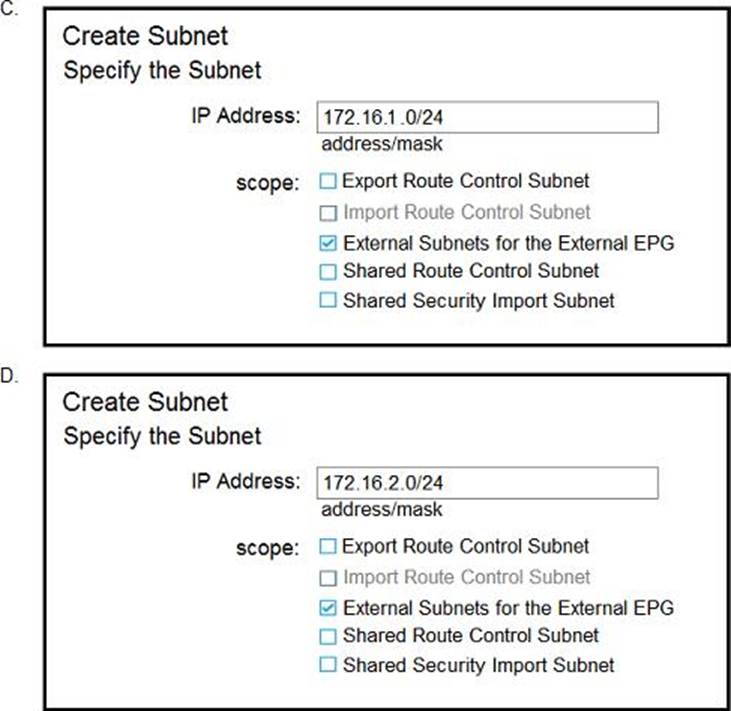
Which configuration must be implemented on L3Out EBGP to advertise out of the fabric 172.16.2.0/24 network that is learned from L3Out OSPF?
正解:
Explanation:
To advertise the 172.16.2.0/24 network learned from L3Out OSPF out of the fabric via EBGP, a subnet must be created within the L3Out’s External EPG and marked as “Shared Route Control Subnet.” This setting allows the route to be advertised to external routers through EBGP.
Reference: = Implementing Cisco Application Centric Infrastructure Official Cert Guide